



A Comprehensive Analysis of the Working Principle of the TIG Torch
 Apr 23, 2025|
 View:2191
In the fields of aerospace, automotive manufacturing, and other high-precision welding industries, the TIG welding torch, with its core design of a non-consumable tungsten electrode and inert gas protection, has become the key equipment for achieving high-quality welds. As industrial demands for welding precision and efficiency rise, the technology behind TIG welding torches has continuously evolved - from traditional air-Cooled TIG Torches to advanced water-cooled TIG torches, integrating material science, thermodynamics, and engineering design. This article delves into the structure, working principles, and operational scenarios of TIG welding torches, offering a deep understanding of how they achieve industrial-level performance with millimeter-level control.

Structural Analysis of the TIG Welding Torch: The Scientific Logic of Modular Design
The core function of the TIG welding torch is to stabilize the arc, protect the molten pool, and efficiently dissipate heat. Its structure can be broken down into four major modules:
Tungsten Electrode and Clamping System
Non-consumable Tungsten Electrode: Made from thoriated or ceriated tungsten alloys with a melting point as high as 3400°C, ensuring stable arcs and minimal electrode wear. The diameter of the electrode typically ranges from 0.5-6.4mm, dynamically matching the welding current (5-400A).
Electrode Holder and Clamp: The tungsten electrode is fixed using threaded or spring-loaded clamping systems, ensuring uniform current conduction and preventing arc deflection.
Gas Nozzle and Protective Gas Flow
Laminar Flow Nozzle: Cylindrical or conical ceramic nozzles (with aperture sizes ranging from 8-20mm) direct argon gas to form a laminar protective shield, preventing contamination of the molten pool by oxygen and nitrogen.
Gas Flow Control: Argon gas flow is typically set at 5-25L/min, evenly covering the molten pool via internal gas channels, preventing porosity and oxidation defects.
Cooling System: Comparing Air-Cooled and Water-Cooled Performance
Air-Cooled TIG Torch: Relies on the flow of argon gas for heat dissipation, suitable for low-current (≤150A) short-duration tasks, inexpensive but with limited cooling efficiency.
Water-Cooled TIG Torch: Features built-in copper tubing for circulating coolant, capable of handling high-load welding (over 300A). The torch body temperature can drop by 60% during continuous operations, preventing tungsten electrode overheating and oxidation.
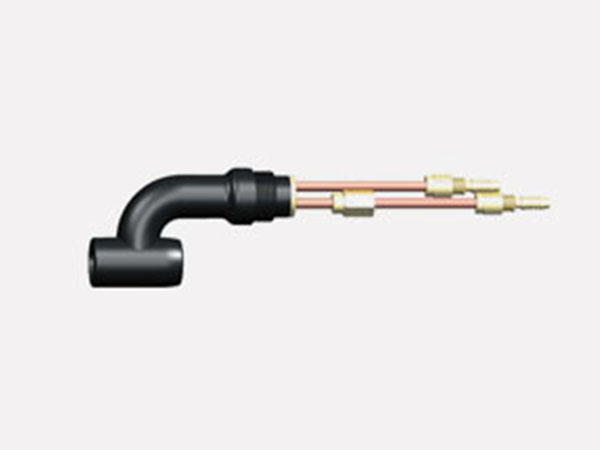
Functional Expansion Interfaces
Wire Feeding Mechanism: Some torches integrate a mechanical wire feeding system for semi-automatic welding, improving efficiency in thin-sheet butt welding.
High-Frequency Arc Starting Module: Uses high-voltage pulses (2000-3000V) to ionize the gas and start the arc non-contact, reducing tungsten contamination.
Arc Generation and Molten Pool Protection: The Core Working Principle of the TIG Welding Torch
Arc Ignition and Energy Transfer
High-Frequency Arc Ignition: The high-frequency generator produces an instant high voltage, breaking down the air gap between the electrode and workpiece, establishing a conductive path.
DC/AC Mode Selection: Direct current (DC) with positive polarity (workpiece positive) is suitable for welding stainless steel and titanium alloys, offering high heat efficiency. Alternating current (AC) is used for aluminum and magnesium alloys, utilizing the cathode cleaning action to remove oxide films.
Inert Gas Protection Mechanism
Dual Gas Flow Protection: Inner argon gas directly shields the arc, while outer gas flow extends the protection range, preventing interference from side winds (wind resistance < 2m/s).
Pre- and Post-Gas Flow: Gas flow starts 0.5 seconds before welding and continues for 2-3 seconds after welding, ensuring the molten pool remains protected during the solidification stage.
Heat Input and Penetration Control
Current-Voltage Coordination: For fine welding of thin sheets at low currents (10-50A), the arc length is controlled between 1-3mm. For thick plate welding with high currents (above 200A), the arc distance is extended to 4-6mm to increase penetration.
Pulse Technology: By using periodic current peaks (e.g., 100Hz pulse), heat accumulation is reduced, making it suitable for welding ultra-thin materials (0.1-3mm) and decreasing distortion by 40%.
Operational Optimization and Maintenance: Key Factors to Extend the Life of the Welding Torch
Tungsten Electrode Grinding and Angle Selection
Tapered Geometry: For DC welding, a 30° cone-shaped tip is used, while for AC welding, the tip is flattened to form a hemispherical shape to reduce arc drift.
Clamping Length: The tungsten electrode typically extends 3-5mm from the nozzle; excessive length can cause airflow disruption, while insufficient length restricts visibility.
Cooling System Maintenance
Regular Cleaning of Water Channels: Water-Cooled TIG Torches require monthly deionized water flushing to prevent scale buildup that can block cooling efficiency.
Seal Detection: Check O-rings and quick-connect fittings to avoid coolant leaks that could cause short circuits.
Common Troubleshooting
Unstable Arc: Check for tungsten contamination (blackening or melting) or gas purity (argon ≥99.99%).
Nozzle Carbon Buildup: Caused by insufficient gas flow or improper torch angle; adjust the angle to 15°-20° and increase the flow rate.
Application Scenarios: Versatile Adaptation from Microelectronics to Heavy Equipment
Precision Thin Sheet Welding: Pulse TIG torches with 0.5mm tungsten electrodes are used for welding 0.1mm stainless steel sheets, achieving distortion-free joints.
Pipeline All-Position Welding: Water-Cooled TIG Torches, coupled with flexible cables, are ideal for overhead and vertical welding of oil pipelines, achieving a weld formation rate of over 98% with single-side welding.
High-Temperature Alloy Repair: For welding niobium alloy aircraft components, a helium-argon gas mixture (Ar+He 50%) is used to enhance arc penetration.
Conclusion: Technological Innovation Driving the Future of Welding
The TIG welding torch, through its modular design and precise control, converts arc energy into reliable industrial manufacturing. With the integration of intelligent sensors and adaptive cooling technologies, future TIG torches will further overcome efficiency barriers, becoming indispensable core tools in high-end manufacturing. Whether in laboratory-level micro-welding or large-scale shipbuilding, the precision artistry of this “millimeter-level” welding process will always be at the heart of it all.