



Uncovering the Working Principle and Technological Breakthroughs of Plasma Cutting Torches
 Apr 02, 2025|
 View:2016
In the field of metal processing, the Plasma Cutting Torch has become a core processing tool for conductive materials such as stainless steel and aluminum due to its cutting efficiency, which is like "cutting butter with a hot knife". Its core technology lies in ionizing ordinary gases into high-temperature plasma and achieving precise cutting through energy focusing. This article will deeply analyze the physical mechanism, core components and process adaptation logic of the plasma cutting torch, and discuss how the Air Plasma Cutting Torch reduces costs through gas innovation, providing cost-effective solutions for industrial users.
1. Generation of Plasma Arc: From Gas Ionization to Energy Focusing
Gas Ionization and Arc Compression
When the plasma cutting torch works, an arc is first initiated between the tungsten electrode and the nozzle by a high-frequency generator. Compressed air or other working gases are ionized by the high temperature (18,000-30,000℃) of the arc to form conductive plasma. The contraction design of the nozzle reduces the arc diameter to 1-3mm through the mechanical compression effect, and the energy density is increased to more than 10 times that of the traditional oxy-acetylene flame, achieving the instantaneous melting of metals.
Double-stage Acceleration and Kinetic Energy Conversion
The ionized plasma undergoes two-stage acceleration:
-Primary acceleration: The kinetic energy generated by gas expansion drives the plasma jet.
-Secondary acceleration: The Lorentz force of the electromagnetic field on charged particles makes the jet velocity reach 800-1,500m/s. This high-speed particle flow can instantly blow away the molten metal, forming a fine cutting edge with a width of only 0.5-3mm.
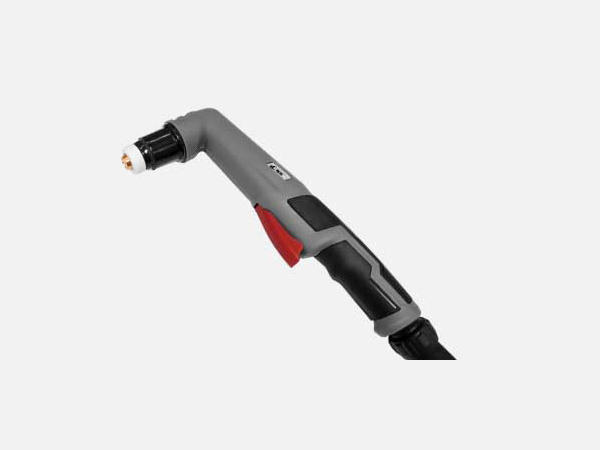
2. Design of Core Components: The Balance of Material Science and Thermal Management
Electrode-Nozzle Collaborative System
-Tungsten electrode: A tungsten alloy containing 2% thorium oxide is used. The melting point (3,422℃) is much higher than the arc temperature. The electrode loss is reduced to 0.1mm/hour by cooperating with the water-cooling structure.
-Copper nozzle: The inner wall is chrome-plated to improve the arc-erosion resistance. The aperture tolerance is controlled within ±0.05mm to maintain the stability of the plasma arc.
Composite Insulation and Thermal Protection
The torch body adopts a combined design of an aluminum oxide ceramic insulation layer (with a withstand voltage of ≥30kV) and a silicone rubber sealing ring, which not only blocks current leakage but also can withstand radiant heat of 1,200℃. The multi-layer bellows structure allows the nozzle to freely expand and contract during thermal expansion, avoiding sealing failure.
3. Economic Breakthrough in Gas Selection: The Popularity of Air Plasma Technology
Technological Innovation of Replacing Inert Gases with Air
Traditional plasma cutting relies on a mixture of argon and hydrogen gases, while the Air Plasma Cutting Torch directly uses compressed air as the working medium. The oxygen in the air undergoes an oxidation reaction with the metal at high temperatures, releasing additional heat energy, which increases the cutting speed of low-carbon steel by 15%-20% and reduces the gas cost by 70%.
The Special Value of Nitrogen-Assisted Cutting
For high-alloy materials such as stainless steel, nitrogen is used as the protective gas to form an inert environment and avoid the oxidation and discoloration of the cutting surface. Through the dual-gas-path design, the gas mode of the same equipment can be quickly switched, and the cutting-surface quality can reach a mirror-like effect with Ra≤12.5μm.
4. Adaptation to Industrial Scenarios: From Precision Cutting of Thin Plates to Heavy-Duty Structure Processing
Automobile Manufacturing and Precision Processing
For example, during the cutting of 0.5-6mm thin plates, the accuracy of the plasma cutting torch can reach ±0.2mm. The the batch production of complex contours can be achieved in combination with the CNC system. Compared with laser cutting, the efficiency becomes 30% higher, and there is no need for secondary grinding.
Heavy-Duty Application in Building Steel Structures
High power plasma systems (greater than 400A) are capable of cutting 150mm thick carbon-steel plates. The invent technology of water-cooling secondary compression is applied to relate energy concentrate of the arc by 3 times. The per unit time of the metal-removal rate can reach 8kg/min, which meets the processing requirements of large components such as bridges and ships.
Breakthrough in Portability for Emergency Repairs
The micro-air plasma cutting torch (≤9 kg) uses inverter-power-supply technology. It can also cut through metal 30 mm thick when no gas is available by water-vapor ionization, making it ideally suited for field emergency maintenance and disaster rescue.
5. Intelligent Maintenance and Life-Extension Strategies
Preventive Replacement Cycle Management
-Matching replacement of electrode and nozzle: When the electrode loss reaches 1.5mm or the nozzle aperture expands by 15%, they need to be replaced simultaneously to avoid the decline in cutting-edge quality caused by arc deviation.
-Eddy-current-ring detection: Check the oxidation degree of the copper eddy-current ring every month to ensure the stability of the gas swirl.
Standardized Cleaning and Calibration Procedures
-Arc-cavity cleaning: Wipe the metal dust on the surface of the insulation layer with anhydrous ethanol to prevent arc creeping.
-Concentricity calibration: Use a laser locator to adjust the concentricity deviation of the electrode and the nozzle to ≤0.1mm, which can extend the service life of the components by more than 30%.
Conclusion: Plasma Cutting Torch-Redefining the Efficiency Boundary of Metal Processing
From the basic research of arc physics to the engineering application of gas dynamics, the technological iteration of the plasma cutting torch has always focused on the improvement of energy density and cost control. The popularity of the Air Plasma Cutting Torch marks the penetration of this technology from high-end manufacturing to the general-purpose field. Whether it is the automotive components with micron-level accuracy or the hundred-ton-class ship-hull structures, the plasma cutting torch is promoting the metal-processing industry into a high-efficiency era in a more intelligent and economical manner.