TIG 9 Torch Showdown Flex Head vs Rigid Head vs Air-Cooled
 Oct 28, 2026|
 View:1
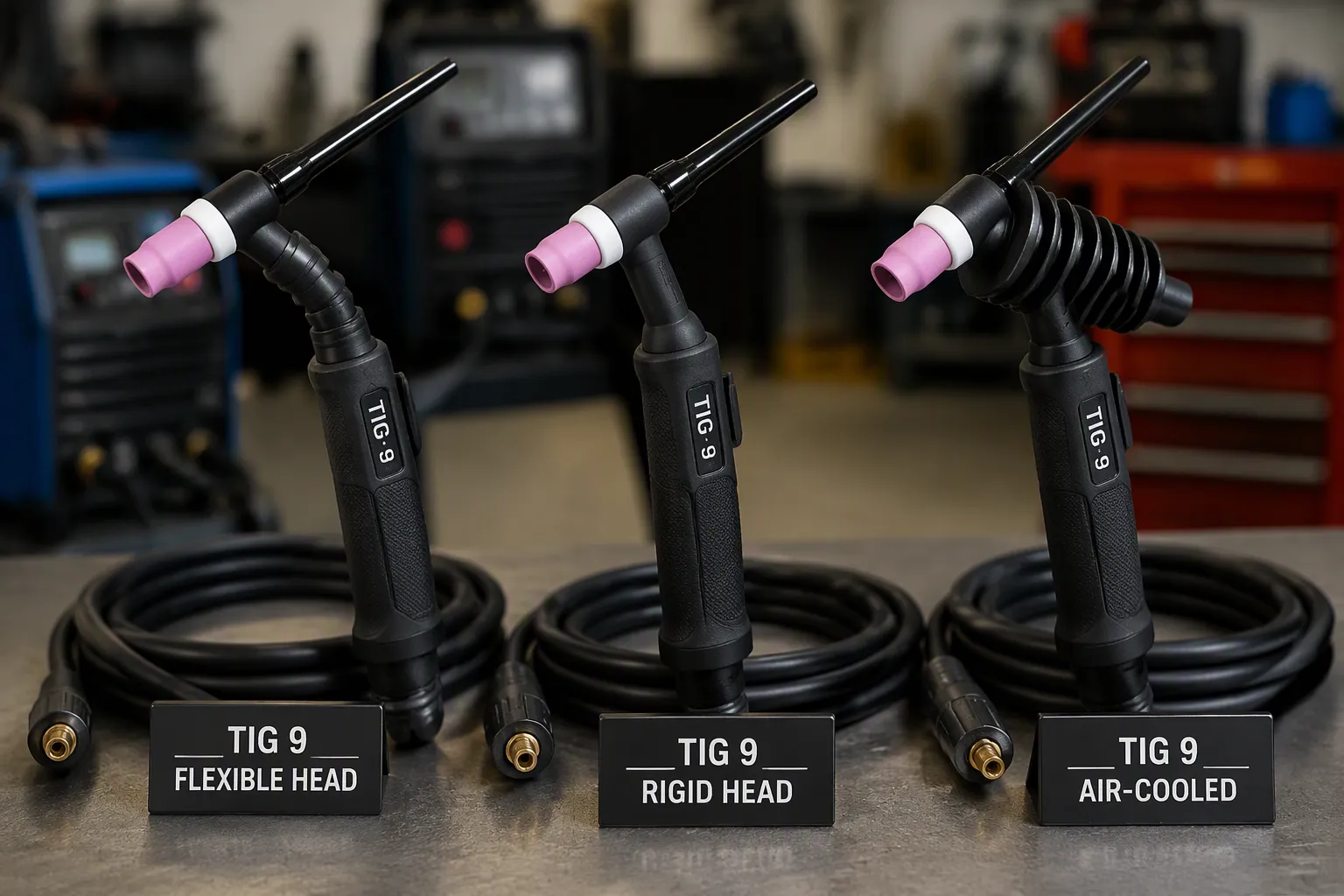
A TIG 9 Torch can be specified with a flex head, a rigid head, or an air-cooled body; the three choices answer different welding problems.
What actually changes in daily welding performance when a welder picks a flex head, a rigid head, or an air-cooled torch? Three differences matter most. Head articulation trades access against stability. Cooling method sets the amperage ceiling and duty cycle. Both then shape comfort, compliance, and cost.
Flex and rigid describe head style. Air-cooled describes cooling method. These are separate decisions, and a welder can combine them freely within a TIG 9 Torch.
For tight stainless work, a flex head is usually the better fit. Bench and fixture work favor a rigid head. Light-to-medium general fabrication suits an air-cooled torch. That default answers the question quickly. The sections below explain why each fit holds.
Key Takeaways
Flex head torches bend to reach tight spots, but the neck can shift during welding.
Rigid head torches stay fixed for steady, repeatable welds on flat bench work.
Air-cooled torches need no cooler, which makes them light and portable for field work.
All three configurations share one rating: 125 A DC and 80 A AC at a 35% duty cycle.
Choose a flex head for obstructed joints and a rigid head for repetitive parts.
Air-cooled torches cost less than liquid-cooled setups because no coolant loop is required.
A 9-series torch tops out at its own rating; work that needs more current calls for a larger or water-cooled body.
Match the torch duty cycle to the machine's duty cycle to avoid overheating.
Flex Head TIG 9 Torch
Amperage and Duty Cycle
A flex head TIG 9 Torch carries the same electrical rating as its rigid counterpart. The flexible neck changes the shape of the torch, not its capacity. A typical flex unit runs 125A DCSP at 35% duty cycle, with an 80 A AC rating for alternating-current work, a 70° head angle, and tungsten capacity from 0.5 mm to 2.4 mm (0.020 in to 3/32 in). The small 9-series body keeps the front end compact, and the torch body weighs about 85 g (3 oz) at 177.8 mm (7 in) long.
This unit delivers 125 A DC output, which suits daily work on thin metal. At 35% duty cycle the welder gets 3.5 minutes of arc time in any 10-minute period, so short passes are the norm and heat builds more slowly inside the body.
Heat in Tight Joints
Tight joints force a welder to work in short passes. That rhythm suits the 35% duty cycle well. The welder lays a bead, repositions, and lets the torch recover. Heat builds inside the body during each pass, and the pause between passes gives it time to escape. A flex neck also lets the welder angle the cup without twisting the wrist, which reduces the time spent hovering near hot metal.
Fit and Comfort
The flexible section is a wound copper tube. This construction explains the bend. Interlocking copper rings let the neck articulate while still carrying current to the electrode. The same construction demands care. Welders should bend the neck by hand at a gentle radius and avoid sharp kinks, which can stress the tube over time.
Pros: Access and Adjustability
A flex head reaches where a rigid torch cannot. The welder can curve the neck around a pipe, into a corner, or under an obstruction. One torch then covers several joint types. Many welders value this versatility, and they treat the flex neck as a general-purpose tool that reduces torch changes.
Cons: Stability and Setup
The flex neck can drift under heavy handling. A welder who presses the cup against the work may find the angle shifts mid-pass. Setup also takes a moment, because the welder must set the neck angle before striking an arc. Some welders question whether the extra cost over a rigid head is worth it. Others find the access pays for itself on complex parts. Both views hold, and the right answer depends on the joint geometry a shop sees most.
Typical Uses
Flex heads suit stainless tube work, repair jobs, and any joint with limited clearance. They also help welders who rotate between part families on one bench.
Compliance and Cost
Safety and Certification
A flex torch follows the same safety rules as any air-cooled torch. The welder needs correct shielding gas flow, proper tungsten grinding, and rated cable and connectors, all of which sit inside the federal welding and cutting safety requirements. The power cable uses the standard threaded fitting for the 9 series, so a torch can move between power sources without an adapter.
Price vs Value
Flex heads cost more than rigid heads. The premium buys adjustability, not amperage. A shop with repetitive straight joints may not recover that premium. A shop with varied, obstructed work usually does.
Choosing between a flex neck and a fixed neck?
Golden Globe builds the WP-9 body in standard, flexible, valve, flexible valve and pencil versions, with 4 m or 8 m cable and standard WP-9 consumables.
Get a QuoteView WP-9 TorchRigid Head TIG 9 Torch
Amperage and Duty Cycle
A rigid head TIG 9 Torch shares the same electrical platform as the flex version. The fixed neck changes handling, not capacity. The torch runs 125 A DC and 80 A AC at a 35% duty cycle, with a 70° head angle and tungsten capacity from 0.5 mm to 2.4 mm (0.020 in to 3/32 in). The torch body weighs about 85 g (3 oz) and measures 177.8 mm (7 in) long.
Stable Arc on Bench Work
Bench work rewards a torch that holds its angle. The rigid neck keeps the cup at a fixed relationship to the handle, so the welder's wrist position maps directly to arc direction. That fixed geometry produces a consistent arc length pass after pass. On a fixture table, the welder can rest the torch hand and drive the bead with the forearm. The arc stays steady, and the heat input stays even along the joint.
Fit and Comfort
A rigid torch feels predictable in the hand. The welder learns one grip, and that grip works for every joint on the bench. Setup is immediate, because the neck angle never changes. The trade-off appears when the joint geometry forces an awkward wrist position.
Pros: Repeatability and Durability
Repeatability is the rigid head's main advantage. Identical parts get identical torch angles, which helps a shop hold consistent bead profiles across a production run. Durability follows the same logic. A solid neck has no moving section to stress, so it tolerates shop handling and the occasional bump against a fixture. Welders who share torches across shifts also benefit, because the tool arrives in the same shape every time.
Cons: Limited Tight Access
The fixed neck cannot curve around an obstruction. A welder facing a tube cluster or a recessed corner must change the wrist angle, the torch, or the part position. Each of those changes costs time. Some joints simply stay out of reach for a rigid torch, and the welder must switch to a flex unit to finish the pass.
Typical Uses
Rigid heads suit bench fabrication, fixture work, and repetitive part families. They also fit training environments, where a fixed angle helps new welders learn arc control without an extra variable.
Compliance and Cost
Safety and Certification
A rigid torch follows the same safety practice as any air-cooled unit. The welder needs correct shielding gas flow, proper tungsten preparation, and rated cable and connectors. The power cable uses the same threaded fitting as the flex version, so one cable set serves either head.
Price vs Value
Rigid heads cost less than flex heads. A shop with steady, accessible joints gets full performance at the lower price. The savings compound across a fleet of torches, and the simpler neck has no articulating section to wear.
Air-Cooled TIG 9 Torch
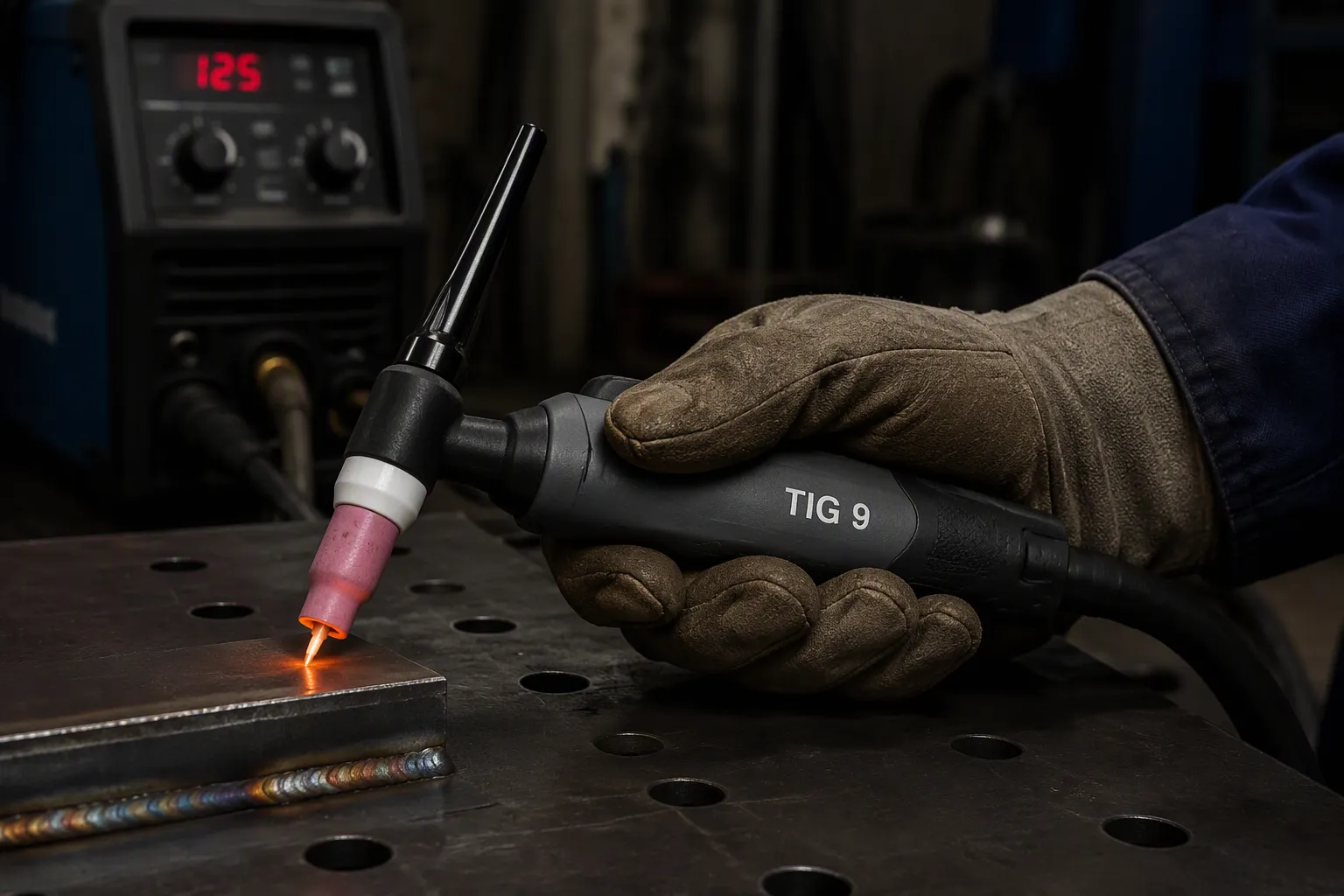
An air-cooled torch sheds heat through the body and the surrounding air, so no cooler, coolant line, or water supply is needed.
Amperage and Duty Cycle
An air-cooled torch suits low-to-medium current work. The torch body sheds heat to the surrounding air, so the welder can run it without a cooler, a coolant line, or a water supply. That simplicity defines the category. The Golden Globe TIG 9 Torch line is rated at 125 A DC and 80 A AC with a 35% duty cycle, and it accepts tungsten from 0.5 mm to 2.4 mm. Those figures set the working envelope. A welder who stays inside that envelope gets steady performance.
Heat Buildup on Long Runs
The longer a welder welds, the hotter the torch gets. Air cooling depends on the surface area of the body and the surrounding airflow, so heat leaves slowly. A short pass lets the body recover between beads. A long continuous run does not. The handle warms first, then the neck, and eventually the heat reaches the point where the welder must pause. That pause is not a defect. It is the nature of air cooling, and the 35% duty cycle describes it plainly: 3.5 minutes of arc time per 10 minutes at the rated current.
Air vs Liquid Cooling
Air-cooled torches trade that capacity for portability and simplicity. Liquid-cooled torches move heat away through a coolant loop, which supports higher current and longer runs. A welder gains freedom from a cooler unit and its hoses, and gives up the ability to hold high amperage for extended periods. Neither approach suits every shop. The job decides.
Fit and Comfort
Pros: Light and Low Maintenance
An air-cooled torch carries less weight than a liquid-cooled unit, because no coolant hoses run through the cable. The Golden Globe line offers a BWT-Ⅲ handle in black-gray, with customizable colors and styles, in gas and power whole or gas and power separate configurations. Cable lengths come in 4 m or 8 m. Maintenance stays simple. There is no coolant to check, no pump to service, and no leak to trace.
Cons: Lower Current Ceiling
The current ceiling sits at 125 A DC and 80 A AC, below what a liquid-cooled torch allows. A welder who needs sustained higher amperage must slow down, shorten passes, or change torch class. The 80 A AC limit also restricts AC work on thicker aluminum compared with water-cooled options.
Typical Uses
Air-cooled torches fit light fabrication, field repair, portable work, and shops without a cooler. The WP-9 body variants cover standard, flexible, valve, flexible valve, and pencil styles. Flex and rigid head styles both exist within air-cooled torches, so cooling choice and head choice remain separate decisions. The manufacturer lists a registered design patent (ZL202130291871.4) for the handle.
Compliance and Cost
Safety and Certification
An air-cooled torch follows standard safety practice. The welder needs correct shielding gas flow, proper tungsten preparation, and rated cable and connectors, together with the ventilation that guidance on welding fume control calls for. Welding fume is a respiratory hazard in every process, and extraction or general ventilation is part of the setup rather than an optional extra.
Price vs Value
Air-cooled torches generally cost less than liquid-cooled setups, since no cooler is required. Actual prices vary widely with cable length, handle type, and connector, so a shop should compare complete configurations rather than bare torch bodies. The Golden Globe line adds a full consumables range, including collets, collet bodies, gas lenses, ceramic nozzles, and back caps, all compatible with standard WP-9 parts.
Running long, hot passes?
When the work sits above the 9-series rating, a 17 or 18 series torch keeps the arc going without a pause. Send the material, thickness and duty cycle, and the team can match a body to the job.
Get a QuoteCompare TIG TorchesSide-by-Side Comparison
Performance at a Glance
The three options share one electrical platform. A flex head, a rigid head, and an air-cooled body all run the same 9-series rating. The differences sit in handling and heat management, not in raw output.
| Spec | Flex Head | Rigid Head | Air-Cooled |
|---|---|---|---|
| Current rating | 125 A DC / 80 A AC | 125 A DC / 80 A AC | 125 A DC / 80 A AC |
| Duty cycle | 35% | 35% | 35% |
| Tungsten range | 0.5 mm–2.4 mm | 0.5 mm–2.4 mm | 0.5 mm–2.4 mm |
| Head angle | 70°, adjustable | 70°, fixed | 70° |
| Body weight | ~85 g | ~85 g | ~85 g |
| Cable options | 4 m or 8 m | 4 m or 8 m | 4 m or 8 m |
A welder reading this table sees the real story. Head style does not raise the amperage ceiling. Cooling method does not change the head angle. Each choice solves a different problem, and a shop can pair them as needed.
Access and Comfort
Access favors the flex head. The wound copper neck curves around pipe clusters, recessed corners, and obstructions that stop a fixed torch. That reach costs a little setup time, because the welder sets the angle before the arc starts. The neck can also drift when a welder presses the cup against the work.
Comfort favors the rigid head on repetitive work. One grip works for every joint on the bench, and the fixed angle maps wrist position straight to arc direction. The welder pays for that predictability with awkward wrist positions on obstructed parts.
Air cooling shapes comfort in a different way. No coolant hoses run through the cable, so the torch feels lighter in the hand. The body warms during long runs, and the welder manages that heat with short passes and pauses. A welder who rotates between part families often finds the flex neck worth the extra setup, while a production bench rarely needs it.
Cost and Compliance
Cost tracks complexity. Rigid heads cost least, flex heads carry a premium for the articulating neck, and air-cooled setups undercut liquid-cooled systems because no cooler is required. The spread between suppliers is wide, and it usually reflects cable length, handle type and connector rather than the neck alone. A shop buying several units should weigh that spread against the joint types it actually welds.
Compliance stays constant across all three. Each option follows the same safety practice: correct shielding gas flow, proper tungsten preparation, and rated cable and connectors. The power connection uses the same threaded fitting across the 9 series, so a welder can move a TIG 9 Torch between power sources without adapters. Certification and inspection routines do not change with head style or cooling method. The welder's technique and the shop's procedures carry far more weight than the torch variant.
Which TIG 9 Torch to Choose
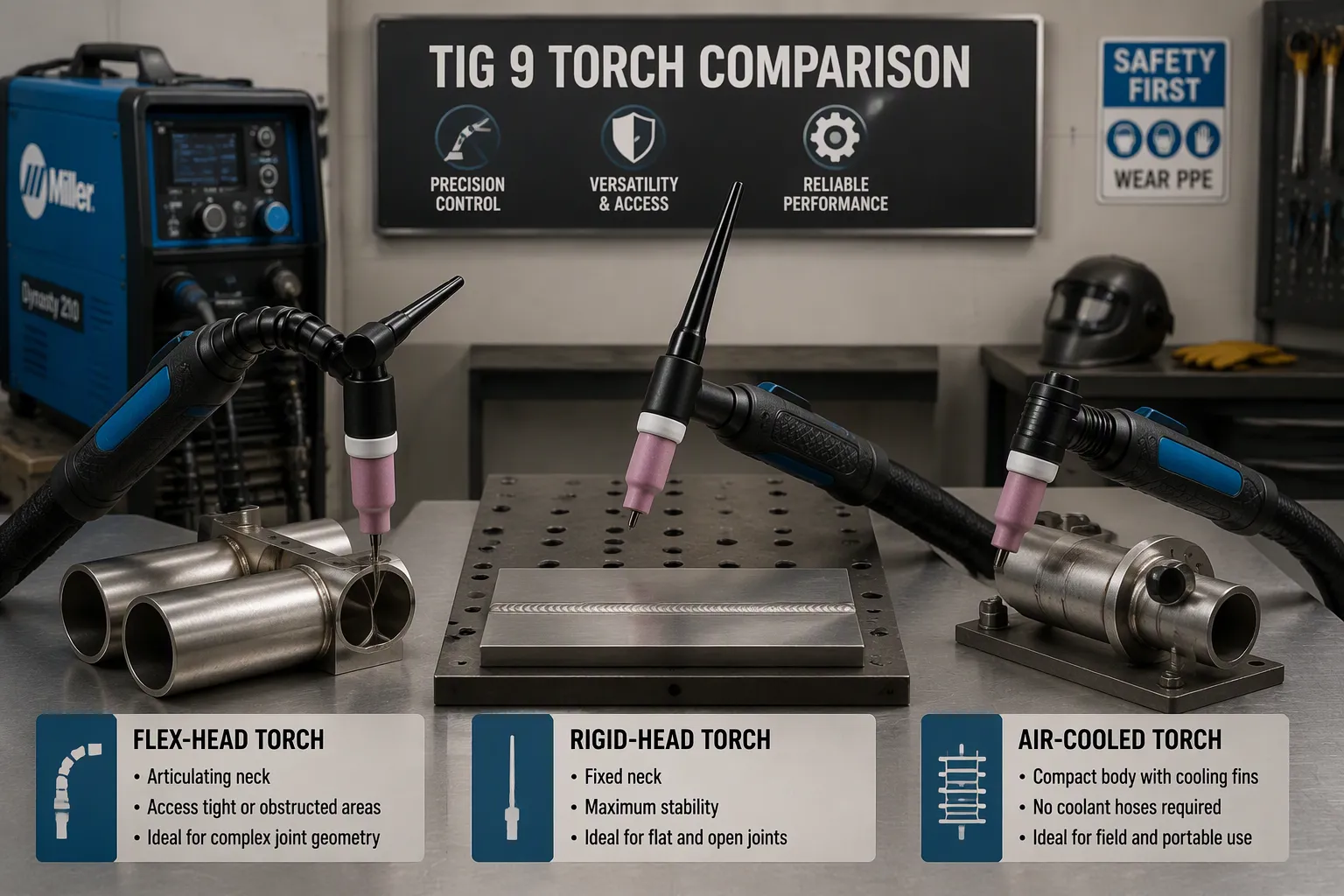
The joint in front of the welder decides more than any spec sheet, and the neck, the cooling method and the cable can be matched to it.
Match Your Work
The joint in front of the welder decides more than any spec sheet. A flex head earns its place when the work hides behind obstructions. Tube clusters, recessed corners, and repair jobs on assembled parts all reward a neck that curves around the obstacle. The welder sets the angle once, reaches the joint, and finishes the pass without repositioning the part.
A rigid head earns its place on the bench. Fixture tables, repetitive part families, and production runs reward a fixed angle. The welder learns one grip, and that grip holds pass after pass. Bead profiles stay consistent across a run, and a shared torch arrives in the same shape every shift.
An air-cooled torch earns its place on light, portable work. Field repair, small assemblies, and shops without a cooler all suit a body that sheds heat to the air. The welder gains freedom from hoses and a pump. The trade-off is a lower current ceiling and a body that warms during long runs.
A simple test helps. Look at the last twenty joints a shop welded. If most needed an awkward wrist position, choose the flex head. If most sat flat on a table, choose the rigid head. If most happened away from the bench, choose the air-cooled body.
Match Your Budget
Cost tracks complexity, and the spread is real. Rigid heads cost least because the neck has no moving section. Flex heads carry a premium for the articulating neck. Air-cooled setups undercut liquid-cooled systems because no cooler is required. Two 9-series bodies with different necks still cost far less than a water-cooled torch plus its cooler and hoses.
A shop buying several units should weigh that spread against the joint types it actually welds. A production bench with steady, accessible joints gets full performance from the lower-priced rigid head. A repair shop with varied, obstructed work usually recovers the flex premium through fewer torch changes. A field crew gains more from portability than from either neck style.
Budget also covers consumables. A full range of collets, collet bodies, gas lenses, ceramic nozzles, and back caps keeps a torch running, and standard WP-9 compatibility means a shop can source parts from more than one supplier. That flexibility matters more over a torch's life than the initial price difference between neck styles.
Buy Both or Upgrade
Many shops do not face an either-or choice. A flex head and a rigid head share the same electrical platform, the same 125 A DC rating, and the same 35% duty cycle. A shop can keep one of each on the bench and match the torch to the joint. The pair covers more joint types than either head alone, and neither needs a cooler.
The upgrade question is separate. Air cooling has a ceiling, and the welder feels it before the spec sheet shows it. The table below marks the common triggers for moving to a larger air-cooled torch or a liquid-cooled model.
| Condition | Air-Cooled TIG 9 Torch | Liquid-Cooled Torch |
|---|---|---|
| Typical amperage range | Rated 125 A DC and 80 A AC; most work sits at 50–125 A DC | Water-cooled bodies such as the 18 series run 350 A DC and 250 A AC |
| Upper amperage limit | 125 A DC at 35% duty cycle is the ceiling | Needed when the work exceeds the 9-series rating, or when 35% duty is too short |
| Long welding sessions | 35% duty allows 3.5 minutes of arc in each 10 minutes | 100% duty cycle at rated current |
| Higher heat and AC work | 80 A AC ceiling limits thicker aluminum | Higher AC capacity for sustained aluminum work |
For a 125 A torch the ceiling arrives at the rating itself, not at 160 A. The 160 A figure that circulates in welding discussion describes larger air-cooled bodies such as the 17 and 26 series, which run 150 A DC and 200 A DC respectively. A 9-series welder who needs more than 125 A DC has to change torch class. Moving to a water-cooled body adds a cooler, hoses and a coolant loop, so it pays off only when the work runs hot for long periods. A short hobby session on a DC-only machine rarely needs the change. Sustained AC work on thicker aluminum usually does.
One practical rule ties the two decisions together. Match the torch duty cycle to the machine's duty cycle. When the torch feels hot, the machine sits near its maximum duty cycle. That signal tells the welder more than any label.
Flex head for access, rigid head for stability and repeatability, air-cooled for light, portable, low-maintenance work. A short checklist settles most shop decisions:
Most joints hidden behind an obstruction → flex head.
Most joints flat on a fixture table → rigid head.
Work spread across several sites, no cooler on the truck → air-cooled body.
Sustained work above 125 A DC, or long AC runs on aluminum → step up to a larger or water-cooled torch.


Ready to specify a TIG 9 Torch?
Tell us the material, thickness and joint access, and Golden Globe can confirm the head style, cooling method and cable length that fit the work.
Get a QuoteView TIG Torch RangeFAQ
Does a flex head change the amperage rating of a TIG 9 Torch?
No. A flex head and a rigid head share the same electrical platform. Both run 125 A DC and 80 A AC at a 35% duty cycle. The articulating neck changes handling and access, not output. A welder gets the same current ceiling from either head style.
Can a welder combine a flex head with air cooling?
Yes. Head style and cooling method are separate decisions. The WP-9 body comes in standard, flexible, valve, flexible valve, and pencil variants, and each one works within the air-cooled line. A welder picks the neck for access and the cooling method for the job.
How long can a welder run an air-cooled TIG 9 Torch?
The 35% duty cycle sets the rhythm: 3.5 minutes of arc time in any 10-minute period at the rated 125 A DC. A welder lays a bead, pauses, and lets the body shed heat. Short passes work well. Long continuous runs do not, because the handle warms first and then the neck. The pause is normal for air cooling.
What tungsten sizes fit a TIG 9 Torch?
The torch accepts tungsten from 0.5 mm to 2.4 mm (0.020 in to 3/32 in). That range covers most thin-gauge stainless and light steel work. A welder should match the electrode diameter to the amperage and the joint thickness, and use electrodes that meet the specification covering tungsten electrodes for arc welding.
Which head style suits a welder new to TIG?
A rigid head usually fits a new welder better. The fixed 70° angle removes one variable, so the welder learns arc control with a predictable grip. A flex neck adds adjustability, and that adjustability can distract a beginner during early practice.
Do flex and rigid torches use the same consumables?
Yes. Both heads accept standard WP-9 parts, including collets, collet bodies, gas lenses, ceramic nozzles, and back caps. A shop can stock one consumables set and run either torch. Both also use the same threaded power-cable fitting.
When should a shop move from air-cooled to liquid-cooled?
The trigger is work that needs more than the torch is rated for. A 9-series torch tops out at 125 A DC and 80 A AC on a 35% duty cycle, so a welder who needs more current, or a longer duty cycle, has to change torch class. A short hobby session on a DC machine rarely justifies the change. Sustained AC work on thicker aluminum often does.
What cable lengths are available for a TIG 9 Torch?
The line offers 4 m or 8 m cable lengths, catalogued as 12.5 ft and 25 ft. A bench welder usually needs the shorter cable. A field welder or a large fixture setup often benefits from the longer run, which reduces the need to move the machine.
References
[1] Occupational Safety and Health Administration. 29 CFR 1910.252 — Welding, Cutting, and Brazing, general requirements. osha.gov
[2] American Welding Society. AWS A5.12/A5.12M — Specification for Tungsten and Oxide-Dispersed Tungsten Electrodes for Arc Welding and Cutting. aws.org
[3] Health and Safety Executive (UK). Welding — fume and ventilation guidance. hse.gov.uk
[4] Manufacturer product data for the WP-9, WP-17 and WP-18 TIG torch bodies: current rating, duty cycle and tungsten range. blackwolfwelding.com
Figures for current rating, duty cycle and tungsten range follow the manufacturer’s published torch data. Duty cycle percentages assume a 10-minute reference period, the convention used in welding power-source ratings.