



Air-Cooled vs. Water-Cooled Robotic Welding Torches
 Mar 23, 2026|
 View:462
The best robotic welding torch depends on the workload, environment, and budget. Water-cooled torches dominate the market, accounting for 73.4% of industrial applications. They excel in heavy-duty tasks, especially when high amperage or thick materials are involved. Air-cooled torches suit lighter jobs and offer simplicity. Consider these factors:
Factor | Air-Cooled | Water-Cooled |
|---|---|---|
Amperage Limit | Up to 500 amp | Up to 600 amp |
Material Thickness | Thin to medium | Thick and shiny metals |
Duty Cycle | 50% or lower | Above 60% |
Black Wolf manufactures both air-cooled and water-cooled plasma cutting torches, providing options for various welding torch requirements.
Key Takeaways
Air-cooled torches are ideal for light-duty tasks and offer portability, making them suitable for fieldwork.
Water-cooled torches excel in high-amperage applications, providing better heat management for prolonged welding sessions.
Consider the duty cycle: air-cooled torches typically support 50% or less, while water-cooled models can handle over 60%.
Air-cooled torches require less maintenance due to their simple design, reducing downtime and operational costs.
Water-cooled torches need a cooling system, which adds complexity but improves performance in demanding environments.
Choose air-cooled torches for quick setups and mobility; opt for water-cooled torches for consistent quality in heavy-duty applications.
Evaluate your budget: air-cooled torches have lower initial costs, while water-cooled options may save money in the long run through reduced consumable wear.
Match the torch type to your workload and environment to ensure efficient and effective welding operations.
Air-Cooled Torches Overview
Air-Cooled Torch Features
Cooling Method
Air-cooled torches use a straightforward cooling method. They rely on natural air movement to remove heat from the torch during operation. As the torch works, air flows over the torch body, carrying away heat through convection and radiation. This process protects the internal components and keeps the torch at a safe temperature. Because air-cooled torches do not require pumps, hoses, or coolant reservoirs, they offer a simple and effective solution for many welding tasks.
Construction
Manufacturers design air-cooled torches with durability and ease of use in mind. The torch body often features robust materials that withstand high temperatures and rough handling. The absence of a water-cooling system means fewer parts that can fail or require maintenance. For example, Black Wolf’s air-cooled plasma cutting torches demonstrate how industrial-grade construction can deliver reliable performance in demanding environments. Their design supports both precision and efficiency, making them suitable for a wide range of applications.
Air-Cooled Torch Benefits
Simplicity
Air-cooled torches stand out for their simple design. Operators find them easy to set up and use, with minimal training required. The lack of a complex cooling system reduces the chance of breakdowns and lowers maintenance needs. In industrial settings, this simplicity translates to less downtime and lower operating costs.
Portability
Portability is a major advantage of air-cooled torches. These torches do not need coolant hoses or external reservoirs, so they are lighter and easier to move. This makes them ideal for fieldwork, repairs, and remote welding tasks where access to water-cooling infrastructure is limited.
Tip: Air-cooled torches are perfect for mobile welding jobs or situations where quick setup and transport are important.
Advantage | Description |
|---|---|
No coolant hoses or reservoirs, easy to handle in confined spaces | |
Simplified Maintenance | Fewer parts, easier to service, less downtime |
Flexible for Field Work | Ideal for mobile welding where water-cooling is not available |
Air-Cooled TIG Torches
TIG Applications
Air-cooled TIG torches work best for light-duty and mobile welding tasks. Operators often choose them for jobs involving thin to medium materials or when they need to move equipment frequently. These torches suit intermittent welding, repairs, and projects in locations without access to water-cooling systems.
Performance Factors
When comparing air-cooled TIG torches to water-cooled TIG torches, several factors stand out:
Feature | Air-Cooled TIG Torches | Water-Cooled TIG Torches |
|---|---|---|
Weight | Lightweight and portable | Heavier due to coolant system |
Application Range | Ideal for light-duty and mobile tasks | Suited for high-amperage and prolonged welding |
Amperage Handling | Typically up to 250 amps | Designed for high-amperage applications |
Heat Management | More prone to overheating | Superior heat management with coolant circulation |
Operator Comfort | Less comfortable during extended use | Greater comfort due to reduced heat exposure |
Air-cooled TIG torches provide flexibility and ease of use for many welding professionals. Their lightweight design and simple setup make them a popular choice for fieldwork and smaller projects.
Air-Cooled Torch Limitations
Heat Management
Air-cooled robotic welding torches face challenges in heat management. These torches rely on air flow to cool the torch body, which limits their ability to handle extended welding sessions. When operators use air-cooled torches for prolonged periods or at higher amperage, the torch can overheat. Overheating affects weld quality and may cause premature wear of consumables. Many professionals choose air-cooled torches for light-duty tasks because they are lightweight and easy to operate. However, heat management becomes a concern during continuous welding or when working with thicker materials.
Air-cooled torches struggle to cool down effectively at higher load limits.
Overheating can compromise weld quality and shorten the lifespan of torch parts.
Operators must monitor torch temperature to avoid performance issues.
Heat management remains a critical factor for anyone considering air-cooled torches. These torches perform best in environments where welding sessions are short and the amperage stays within recommended limits. For jobs requiring frequent or prolonged welding, operators often look for solutions that improve heat management, such as using lower amperage or allowing cooling breaks.
Duty Cycle
Duty cycle describes the percentage of time a torch can operate within a ten-minute period before it needs to cool down. Air-cooled torches typically support a duty cycle of 50% or less. This means the torch can weld for five minutes and then must rest for five minutes. The lower duty cycle results from limited heat management capabilities. When operators push air-cooled torches beyond their recommended duty cycle, the risk of overheating increases.
Air-cooled torches are not designed for high duty cycle applications. They work best for intermittent welding, repairs, and projects involving thinner metals. MIG versions of air-cooled torches offer amperage ranges from 150 to 600 amps, while TIG versions range from 50 to 300 amps. These specifications suit low duty-cycle, low-amperage tasks. Operators who need high duty cycle performance often select water-cooled torches instead.
Note: Air-cooled torches excel in mobile and light-duty applications. For high duty cycle or heavy-duty welding, water-cooled torches provide better heat management and longer operating times.
Limitation | Air-Cooled Torch Impact |
|---|---|
Heat Management | Limited cooling, prone to overheating |
Duty Cycle | Lower duty cycle, not suitable for continuous welding |
Weld Quality | May decrease if torch overheats |
Air-cooled torches offer simplicity and portability, but their limitations in heat management and high duty cycle restrict their use in demanding welding environments. Operators must match torch selection to the workload and ensure proper cooling practices to maintain performance.
Water-Cooled Torches Overview
Water-Cooled Torch Features
Cooling System
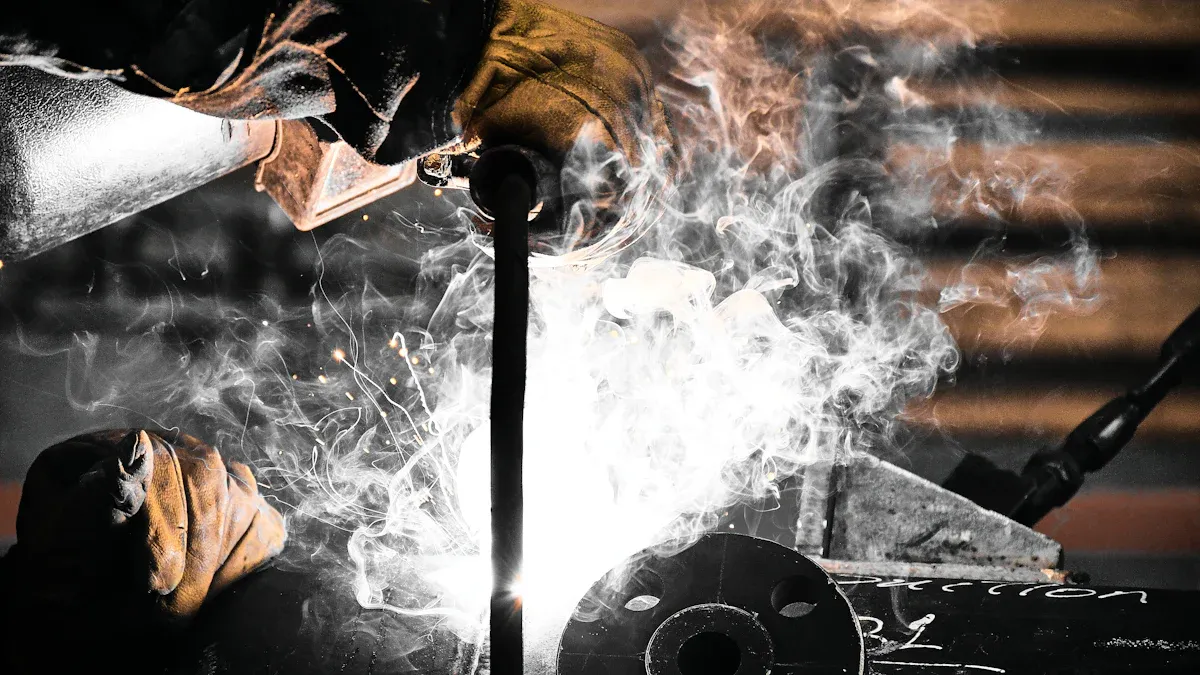
Water-cooled torches use a cooling system that circulates water through the torch body. This system removes heat quickly and efficiently. The torch connects to an external cooler, which pumps water through hoses and returns it after absorbing heat. This process keeps the torch at a stable temperature, even during long welding sessions. Water-cooled torches maintain consistent performance and prevent overheating, making them suitable for demanding environments.
Feature | Water-Cooled Models | Air-Cooled Models |
|---|---|---|
Thermal Management | Superior thermal management with coolant | Relies on air for cooling |
Duty Cycles | Higher duty cycles for prolonged use | Limited duty cycles |
Ergonomic Design | Designed for operator comfort | Varies, often less ergonomic |
Consumable Life | Extended life due to reduced thermal stress | Shorter life due to overheating |
Performance | Consistent arc performance at high amperages | May struggle under high loads |
Build Quality
Manufacturers design water-cooled torches with robust materials and advanced engineering. The build quality improves heat dissipation and extends the life of consumables. Water-cooled torches operate at high duty cycles, handling high amperage loads without thermal stress. The cooling system allows the torch to return to a safe temperature within minutes. This feature supports continuous welding and reduces downtime. The sturdy construction ensures reliability in industrial settings.
Water-Cooled Torch Benefits
High Amperage
Water-cooled torches excel in high amperage applications. They weld at higher amperages for longer periods. Operators use these torches in environments where duty cycles reach 60% or more. The cooling system prevents deterioration of weld quality and supports stable operation under heavy loads. Water-cooled torches deliver consistent arc performance, which is essential for industries like shipbuilding and automotive manufacturing.
Advantage | Description |
|---|---|
Cooling Efficiency | Improved cooling efficiency by over 300%, allowing stable operation under high loads (300-600 amps). |
Welding Quality | Enhanced arc stability, increasing welding pass rates to over 98% in industries like automotive. |
Operational Comfort | Lightweight design reduces welder fatigue, combined with ergonomic features. |
Ergonomics
Operator comfort is a key benefit of water-cooled torches. The cooling system keeps the torch body cool, reducing heat exposure for the operator. Ergonomic design features, such as lightweight construction and balanced handles, help minimize fatigue. Operators can work longer without discomfort. Water-cooled torches support productivity and safety in high-volume welding operations.
Water-cooled torches offer superior operator comfort, making them ideal for extended welding sessions.
Water-Cooled TIG Torches
TIG Performance
Water-cooled tig torches provide excellent heat management and extended duty cycles. They prevent overheating during prolonged use. Operators achieve consistent arc stability, which results in clean and accurate welds. Water-cooled tig torches perform well in critical industries, such as aerospace and shipbuilding, where reliability and precision matter.
Feature | Benefit | Importance in Industry |
|---|---|---|
Heat Management | Prevents overheating during prolonged use | Essential for maintaining performance and reliability |
Extended Duty Cycles | Allows for longer welding sessions without interruption | Crucial for high-precision applications |
Consistent Arc Stability | Ensures a stable welding arc for clean and accurate welds | Vital for sensitive or high-strength materials |
Ideal for Critical Industries | Aerospace, shipbuilding, and other demanding sectors | Necessary for durability and quality in welds |
Application Suitability
Water-cooled tig torches suit heavy-duty and high-volume welding tasks. Operators use them for metal build-up, hard banding, and pipeline construction. The cooling system maintains lower temperatures, which extends consumable life and improves weld quality. Water-cooled tig torches provide precise temperature control, supporting performance in demanding applications.
Water-cooled tig torches excel in industrial environments.
They handle high amperage and prolonged welding sessions.
Operators benefit from reduced fatigue and improved productivity.
Water-Cooled Torch Limitations
Setup Complexity
Water-cooled robotic welding torches offer impressive performance, but they come with a more complex setup compared to air-cooled models. Operators must connect these torches to an external chiller or reservoir unit. This cooling system circulates water through the torch and back to the chiller, which helps manage heat during long welding sessions. The need for extra equipment means that water-cooled torches are bulkier and heavier.
Many facilities must dedicate space for the chiller, hoses, and connections. Integrating the cooling system with existing welding infrastructure can require careful planning. Some workshops may need to modify their layouts to accommodate the additional equipment. The installation process often involves more steps, such as securing hoses, checking for leaks, and ensuring proper water flow.
Note: Operators should always check that all connections are secure before starting the welding process. A loose hose or fitting can lead to leaks or reduced cooling efficiency.
The initial investment for water-cooled torches is higher. The cost includes not only the torch itself but also the chiller, hoses, and installation. For some users, this upfront expense can be a barrier. However, the benefits in high-volume or heavy-duty environments often outweigh these challenges.
Maintenance
Routine maintenance is essential for water-cooled torches. The cooling system contains pumps, hoses, and radiators that require regular inspection. Operators must check for leaks, worn seals, and blockages. Over time, hoses can develop cracks or become brittle, especially in demanding industrial settings. Replacing these parts helps prevent unexpected downtime.
The chiller unit also needs attention. Technicians should monitor coolant levels and clean the radiator to maintain efficient heat transfer. Pumps must operate smoothly to ensure consistent water flow. If any part of the system fails, the torch can overheat, which may damage internal components or affect weld quality.
Water-cooled torches require:
Periodic inspection of hoses and seals
Maintenance of pumps and radiators
Monitoring of coolant levels
Cleaning to prevent buildup in the system
Operators should keep a maintenance schedule to track service intervals. Regular care extends the life of the torch and reduces the risk of breakdowns. While water-cooled torches demand more attention than air-cooled models, their performance in high-demand applications makes them a valuable choice for many industries.
Keeping up with maintenance ensures that water-cooled torches deliver reliable results, even in the most challenging welding environments.
Robotic Welding Torch Comparison
Performance
Heat Dissipation
Heat dissipation plays a critical role in welding automation. The ability of a torch to manage heat affects both productivity and equipment lifespan. Air-cooled torches use airflow to remove heat from the torch body. This method works well for light-duty or intermittent welding tasks. Water-cooled torches use a circulating coolant system, which removes heat much more efficiently. This design allows water-cooled models to handle higher amperages and longer welding cycles.
Air-cooled torches offer simplicity and portability. They suit lightweight jobs and require less maintenance.
Water-cooled torches provide superior heat dissipation. They excel in high-amperage applications and maintain stable temperatures during extended use.
Operators in welding automation often choose water-cooled torches for demanding environments. These torches keep internal components cooler, which helps prevent overheating and extends the life of consumables.
Weld Quality
Weld quality depends on consistent temperature control and stable arc performance. Air-cooled torches can overheat during long or high-amperage welding sessions. Overheating may cause poor weld quality and faster wear of torch parts. These torches work best for low duty-cycle, low-amperage, and thinner metal applications.
Water-cooled torches maintain lower operating temperatures. This stability allows for higher amperages and longer duty cycles. As a result, weld quality remains consistent, and consumables last longer. Water-cooled systems also protect internal components, which supports higher productivity and fewer interruptions.
Air-cooled torches may struggle with weld quality during continuous or heavy-duty use.
Water-cooled torches deliver reliable weld quality, especially in high-volume or precision welding automation.
Cost
Initial Investment
The initial investment for a robotic welding torch varies by cooling method. Air-cooled torches cost less to purchase. Their simple design and lack of external cooling equipment make them affordable for many users. Water-cooled torches require a higher upfront investment. Buyers must consider the cost of the torch, coolant system, hoses, and installation.
Air-cooled torches are less expensive at the start but may not suit every application.
Water-cooled torches cost more initially but offer advanced performance for demanding tasks.
Operating Expenses
Operating expenses include maintenance, consumable replacement, and energy use. Air-cooled torches have lower maintenance needs and do not require coolant. However, they may lead to higher operating costs over time. Overheating can cause premature wear of consumables, which increases replacement frequency.
Water-cooled torches need regular maintenance of the coolant system. This includes checking coolant levels, inspecting hoses, and cleaning radiators. Despite these tasks, water-cooled torches extend the life of consumables and reduce downtime. Their ability to operate at higher amperages for longer periods improves productivity. Over time, these benefits can lower total operating expenses, especially in high-volume welding automation.
Note: While air-cooled torches are cheaper to operate on an hourly basis, water-cooled torches can save money in the long run by reducing downtime and consumable costs.
Maintenance
Routine Care
Routine care ensures reliable operation and safety. The following table outlines key maintenance tasks for each torch type:
Maintenance Task | Air-Cooled Torches | Water-Cooled Torches |
|---|---|---|
Inspect hoses and fittings for leaks | Less frequent maintenance required | More critical to prevent overheating |
Check coolant levels and clarity | N/A | Essential for proper operation |
Ensure proper coolant flow and pressure | N/A | Vital to avoid torch failure |
Clean cooling fins and vents | N/A | Necessary to maintain cooling efficiency |
Verify operation of cooling fans and pumps | N/A | Important to prevent overheating |
Inspect and replace consumables | Regular inspection based on usage | Regular inspection and replacement needed |
Follow torque specifications for installation | Important for performance | Critical to avoid excessive heat and damage |
Operators should inspect hoses and fittings for tightness and leaks. Water-cooled torches require daily checks of coolant levels and regular cleaning of radiator fins. Verifying the operation of cooling fans and using a flow switch to monitor coolant flow helps prevent overheating.
Downtime
Downtime affects productivity and project timelines. Air-cooled torches have low maintenance complexity, which leads to less downtime. Their simple design allows for quick inspections and repairs. Water-cooled torches require more complex maintenance. Checking coolant levels, replacing coolant, and inspecting hoses take more time. This complexity can increase downtime, especially if issues arise with the cooling system.
Type of Torch | Maintenance Complexity | Downtime Impact |
|---|---|---|
Air-Cooled | Low | Less downtime |
Water-Cooled | High | More downtime |
Operators must weigh the benefits of advanced performance against the potential for increased downtime. In high-demand welding automation, water-cooled torches offer superior performance but require careful maintenance planning.
Application Suitability
Task Matching
Choosing the right robotic welding torch depends on the type of task. Each torch type has strengths and weaknesses. Operators must match the torch to the job for the best results.
Torch Type | Pros | Cons |
|---|---|---|
Water-Cooled | Handles high amperage applications. | Needs a water circulation system, which increases setup costs. |
Compact and lightweight for better maneuverability. | Less portable, not ideal for fieldwork. | |
Better heat dissipation for longer duty cycles. | Maintenance required to prevent leaks and failures. | |
Air-Cooled | Simpler design, more user-friendly. | Can become uncomfortable during prolonged use due to heat. |
Cost-effective and portable option. | Limited current handling, unsuitable for high-intensity tasks. | |
Easier to handle in tight spaces or frequent movement. | Shorter duty cycles, requiring more breaks to avoid overheating. |
Water-cooled torches work best for high-amperage, long-duration welding. They fit well in automated production lines, heavy equipment manufacturing, and automotive assembly. These torches keep cool during long shifts and maintain weld quality.
Air-cooled torches suit lighter jobs. They perform well in repair shops, small fabrication projects, and fieldwork. Operators can move them easily and set them up quickly. These torches handle thin to medium materials and short welding cycles.
Tip: For tasks that need frequent movement or quick setup, air-cooled torches offer a practical solution. For continuous, high-power welding, water-cooled torches provide better performance.
Infrastructure Needs
The work environment affects torch selection. Water-cooled torches require more infrastructure. Operators need a water chiller, hoses, and space for the cooling system. This setup works well in fixed locations with stable power and water supply. Large factories and automated welding cells often use water-cooled systems.
Air-cooled torches need less infrastructure. They do not require external cooling equipment. Operators can use them in remote locations, outdoor sites, or places with limited resources. These torches fit well in mobile welding units and small workshops.
Operators should ask these questions before choosing a torch:
Does the facility have space for a water chiller and hoses?
Will the torch move often between workstations or job sites?
Is the welding task high-amperage and continuous, or light-duty and intermittent?
Selecting the right torch improves productivity and reduces downtime. Matching the torch to both the task and the available infrastructure ensures safe and efficient welding operations.
Choosing the Right Torch
Key Questions
Selecting the right robotic welding torch requires careful consideration of several factors. Operators should ask key questions to match the torch to their specific needs.
Workload
The workload determines the cooling method and torch type. Operators must evaluate the amperage requirements and frequency of use.
How often will the torch be used each day?
Will the work take place in a shop or on-site?
Is portability a priority?
Air-cooled torches suit lighter workloads and mobile tasks. Water-cooled torches handle higher amperages and continuous operation. Operators welding thick metals or working in high-volume environments benefit from water-cooled models.
Selection Factor | Ideal Use Case | Recommended Type | Budget Consideration |
|---|---|---|---|
Power Rating | Thick metal welding (½”+ steel) | Water-cooled, 300+ A | $$ (Higher initial cost, long-term savings) |
Duty Cycle | Occasional or light welding | Air-cooled, 150–200 A | $ (Affordable entry-level option) |
Budget
Budget influences torch selection. Air-cooled torches offer a lower initial cost and simpler maintenance. Water-cooled torches require a higher investment but deliver long-term savings through reduced downtime and extended consumable life.
Operators must consider both upfront costs and ongoing expenses. Maintenance, consumable replacement, and energy use affect the total cost of ownership.
Note: Choosing a torch that matches the workload and budget ensures efficient operation and minimizes unexpected expenses.
Cooling Infrastructure
The available cooling infrastructure shapes the decision. Water-cooled torches need a chiller, hoses, and space for the cooling system. Air-cooled torches require minimal setup and fit well in remote or mobile environments.
Operators should assess their facility:
Does the workspace have room for a water chiller and hoses?
Is the welding task stationary or mobile?
Can the infrastructure support continuous, high-amperage welding?
A well-matched torch and infrastructure improve productivity and safety.
Factors for TIG Torches
Robotic TIG welding demands careful torch selection. Operators must evaluate material thickness and production volume to ensure optimal performance.
Material Thickness
Material thickness affects amperage and cooling needs. Thin materials and short welding sessions suit air-cooled TIG torches. Thick metals and prolonged welding require water-cooled TIG torches.
Type of Torch | Suitable Amperage | Welding Session Duration | Ideal Use Case |
|---|---|---|---|
Air-Cooled | Below 200 amps | Shorter sessions | Mobile or fieldwork |
Water-Cooled | Over 200 amps | Long, continuous sessions | Stationary setups, workshops, fabrication shops |
Operators welding thin metals in the field often choose air-cooled TIG torches. Those working with thick materials in a workshop select water-cooled TIG torches for better heat management.
Production Volume
Production volume impacts torch selection. High-volume welding benefits from water-cooled torches due to their ability to maintain stable temperatures and extended duty cycles. Low-volume or intermittent welding suits air-cooled torches.
Operators should consider:
The number of welds required per day
The duration of each welding session
The need for consistent weld quality
Tip: Matching torch type to production volume prevents overheating and ensures reliable welds.
Decision-Making Guide
Operators can follow these steps to select the right torch:
Assess welding requirements, including materials, joint types, and production volumes.
Choose a cooling method based on duty cycle and application demands.
Ensure compatibility with the robotic system and controls.
Consider maintenance needs and spare parts availability.
Plan for operator training and safety protocols.
Consulting manufacturers like Black Wolf helps operators find tailored solutions for their welding needs. Experienced professionals can recommend torches that fit specific applications and environments.
A thoughtful approach to torch selection improves efficiency, reduces downtime, and supports high-quality welding results.
Choosing between air-cooled and water-cooled robotic welding torch models depends on the specific job, work environment, and available budget. Air-cooled options offer portability and simplicity, while water-cooled types handle higher workloads and longer duty cycles. Brands like Black Wolf provide a range of solutions for different needs. Weighing performance, cost, and maintenance helps operators achieve the best results:
Benefit | Description |
|---|---|
Precision | High accuracy reduces errors and rework. |
Consistency | Automated systems ensure uniform results. |
Productivity | Increased speed and efficiency lead to higher output. |
Safety | Robots handle dangerous tasks, improving workplace safety. |
Cost-effectiveness | Long-term savings through reduced labor costs and better material usage. |
FAQ
What is the main difference between air-cooled and water-cooled robotic welding torches?
Air-cooled torches use airflow to remove heat. Water-cooled torches rely on circulating coolant for superior heat management. Water-cooled models handle high-amperage projects and longer welding sessions.
Which torch type improves welding efficiency in robotic mig welding?
Water-cooled torches support higher duty cycles and amperage. They maintain stable temperatures, which boosts welding efficiency in robotic mig welding applications.
Can air-cooled torches be used for high-amperage projects?
Air-cooled torches work best for low duty cycle tasks and lighter workloads. They may overheat during high-amperage projects, so water-cooled torches are preferred for demanding jobs.
How does torch selection affect consumable lifespan?
Water-cooled torches extend consumable life by reducing thermal stress. Air-cooled torches may cause faster wear if used beyond recommended limits. Proper torch selection helps operators save on replacement costs.
What maintenance is required for water-cooled torches?
Operators must check coolant levels, inspect hoses, and clean radiators regularly. Routine care prevents overheating and ensures superior heat management during continuous welding.
Are air-cooled torches suitable for mobile or fieldwork?
Air-cooled torches offer portability and simple setup. They fit well in remote locations or mobile welding units where water-cooling infrastructure is unavailable.
How do I choose the right torch for my welding environment?
Operators should consider workload, amperage needs, duty cycle, and available cooling infrastructure. Matching torch type to the environment improves efficiency and weld quality.
Tip: Consult a manufacturer for guidance on torch compatibility and performance in specific applications.