



TIG Welding Essentials: Best Practices for Choosing Filler Rods and Shielding Gas
 Mar 30, 2026|
 View:1151
Selecting the right filler rods and shielding gas is a fundamental part of TIG Welding Essentials. The correct combination is crucial for protecting the weld pool and the electrode from atmospheric contamination, ensuring a strong, clean weld. According to industry studies, using argon as a shielding gas is a key aspect of TIG Welding Essentials, supporting consistent weld quality. Incorporating helium into argon increases heat input, which is beneficial when welding thicker materials and enhances operator safety. Matching filler rods and gas to the base metal and application is central to TIG Welding Essentials, as it prevents defects and supports reliable performance.
Key Takeaways
Choosing the right filler rod and shielding gas is essential for strong, clean welds in TIG welding.
Use argon as the primary shielding gas for most metals to ensure a stable arc and prevent contamination.
Match the filler rod to the base metal to maintain weld strength and prevent defects.
Consider the welding position and application when selecting materials for optimal results.
Store filler rods in dry, sealed containers to avoid contamination and rust.
Adjust the shielding gas flow rate based on the cup size and welding environment for effective protection.
Inspect all equipment and materials before welding to prevent common issues like porosity and oxidation.
Regular practice and attention to detail improve welding skills and lead to better results.
TIG Welding Essentials Overview
What Is TIG Welding
TIG welding, also known as Gas Tungsten Arc Welding (GTAW), uses a non-consumable tungsten electrode to create precise and clean welds. This process stands out for its ability to produce high-quality joints on a wide range of metals. Operators manually feed a filler rod into the weld pool while controlling the arc with a foot pedal or hand control. TIG welding requires a shielding gas, usually argon, to protect the weld area from contamination.
The table below compares TIG welding with MIG welding, highlighting the unique features and requirements of each process:
Feature | TIG Welding | MIG Welding |
|---|---|---|
Electrode | Non-consumable tungsten electrode | Consumable wire |
Filler Material | Manually fed rod | Automatically fed wire |
Shielding Gas | 100% argon | Argon and CO₂ blend |
Weld Strength | Stronger due to narrow arc | Generally lower than TIG |
Weld Speed | Slower, more time-consuming | Faster |
Weld Aesthetics | Professional, fewer defects | Can vary based on welder skill |
TIG welding excels in applications that demand precision, such as aerospace, automotive, and art projects. It works well with thin materials and delivers welds with a clean appearance.
Why Filler Rod and Gas Choice Matters
The selection of filler rod and shielding gas plays a critical role in TIG Welding Essentials. The shielding gas protects the molten weld pool and the tungsten electrode from harmful atmospheric gases. If these gases reach the weld, they can cause defects like porosity and oxidation. The type of shielding gas also influences arc stability, heat input, and the final look of the weld. Proper gas coverage prevents contamination and ensures consistent, high-quality results.
Choosing the right filler rod is just as important. The filler rod must match the base metal to maintain the strength and integrity of the weld. Using the wrong rod can lead to weak joints and possible failure in service.
Tip: Always check the compatibility of your filler rod and shielding gas with the base metal before starting a project.
Key Selection Factors
When selecting filler rods and shielding gases for TIG welding, operators should consider several key factors:
Base Material: Match the filler rod to the base metal’s chemistry for strong, defect-free welds.
Welding Position: Choose materials and techniques that suit the welding position, with flat positions often providing the best results.
Regulatory Specifications: Follow job and industry standards to ensure compliance and safety.
Shielding Gas Compatibility: Select a gas that works well with both the filler rod and the base metal.
Post-Weld Heat Treatment: Some metals require specific heat treatments after welding to maintain their properties.
Welding Equipment: Ensure the equipment can handle the chosen filler rod and gas, including the correct amperage and settings.
These factors form the foundation of TIG Welding Essentials and help operators achieve reliable, high-quality welds in every application.
Filler Rod Selection

Filler Rod Types for TIG
Common Materials
TIG welding uses a variety of filler rods, each designed for specific metals and applications. The most common materials include carbon steel, stainless steel, and aluminum. Each type of rod contains elements that improve weld quality and performance. For example, ER70S-2 and ER70S-6 are popular choices for carbon steel. Aluminum rods like 4043 and 5356 are widely used for aluminum welding. Stainless steel rods such as ER308L and ER316L offer excellent corrosion resistance.
The table below summarizes the most commonly used TIG filler rods, their key characteristics, and typical applications:
Filler Rod Type | Key Characteristics | Typical Applications |
|---|---|---|
ER70S-2 | Contains aluminum, titanium, zirconium as deoxidizers; excellent for TIG welding cleaned carbon steel; forgiving with imperfect fit-up | Root passes with wide gaps, tubing, repair work, small parts; general TIG welding on carbon steel |
ER70S-6 | Contains high silicon and manganese; good for welding over light mill scale | Open root welds with tight gaps, full penetration butt welds on sheet metal |
Aluminum 4043 | Common TIG filler for aluminum; part of 4xxx series with similar characteristics | General TIG welding on aluminum alloys |
Aluminum 4047 | Similar to 4043, used for TIG welding aluminum | General aluminum welding |
Aluminum 4943 | Another 4xxx series filler rod for aluminum TIG welding | Aluminum fabrication |
Aluminum 5356 | Commonly used aluminum TIG filler rod, part of 5xxx series | Structural and marine aluminum welding |
Classification and Standards
Industry standards help welders select the right filler rod for each job. The American Welding Society (AWS) classifies rods by material and application. For example, ER308L is a stainless steel rod with low carbon content, which improves corrosion resistance. The number "308" identifies the alloy type, specifically for stainless steel with defined chromium and nickel content.
AWS Classification | Description |
|---|---|
ER308L | Electrode or Rod suitable for TIG welding, made of stainless steel with low carbon for improved corrosion resistance. |
308 | Identifies the alloy type, specifically for stainless steel with defined chromium and nickel content. |
Matching Rods to Metals
Carbon Steel
Welders should match the filler rod to the base metal to maintain mechanical properties and prevent weld defects. For carbon steel, ER70S-2 and ER70S-6 are the most common choices. These rods contain elements that help remove impurities and create strong, clean welds. Using the wrong rod can reduce fatigue resistance and cause cracks.
Stainless Steel
Stainless steel requires filler rods that match the base metal’s chemistry. ER308L is suitable for 304 stainless steel, while ER316L works well with 316 stainless steel. These rods provide excellent corrosion resistance and prevent the formation of brittle compounds. Choosing the correct rod ensures the weld remains strong and resists rust.
Aluminum
Aluminum welding uses rods like ER4043 and ER5356. ER4043 is a general-purpose rod for most aluminum alloys. ER5356 offers higher strength and is suitable for applications that require anodizing or exposure to marine environments. Selecting the right rod prevents weld failure and maintains the appearance of the finished product.
Other Alloys
Specialty alloys may require unique filler rods. Welders should always check the base metal’s chemistry and choose a rod that matches or exceeds the required properties. This practice helps avoid brittle welds and ensures long-term durability.
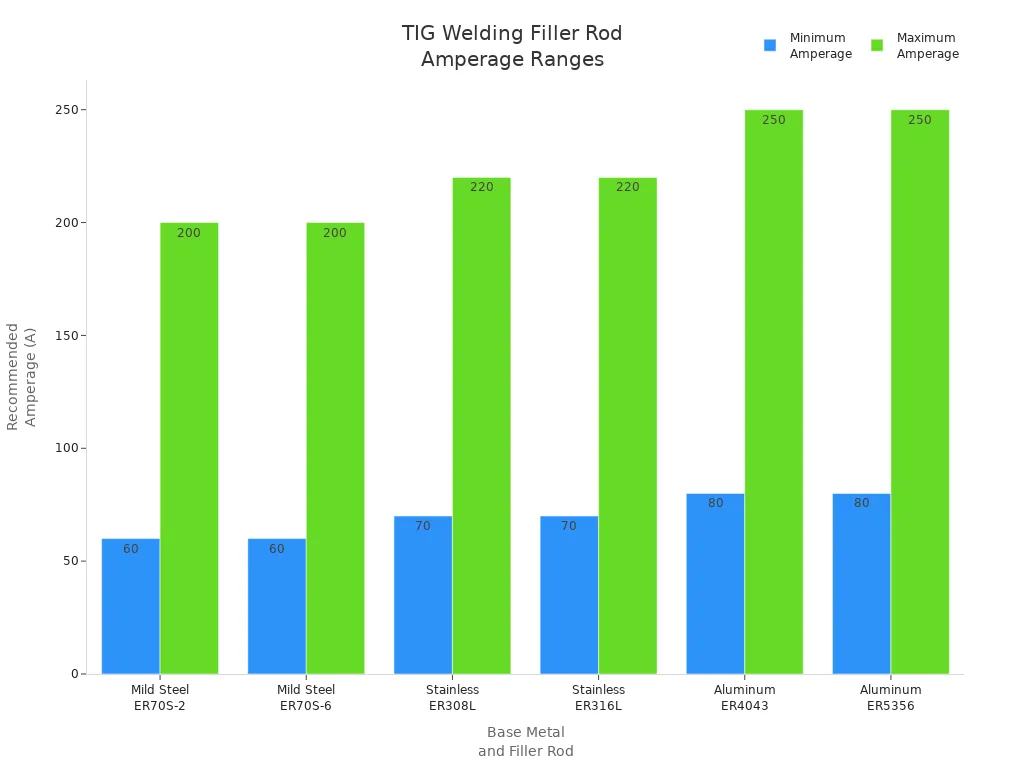
The chart below shows recommended filler rods for common base metals, along with their AWS classification, diameter range, and amperage range:
Base Metal | Common Filler Rod | AWS Classification | Diameter Range | Amperage Range |
|---|---|---|---|---|
Mild Steel | ER70S-2 | A5.18 | 1/16″, 3/32″ | 60–200 A |
Mild Steel | ER70S-6 | A5.18 | 1/16″, 3/32″ | 60–200 A |
Stainless Steel (304) | ER308L | A5.9 | 1/16″, 3/32″ | 70–220 A |
Stainless Steel (316) | ER316L | A5.9 | 1/16″, 3/32″ | 70–220 A |
Aluminum (6061) | ER4043 | A5.10 | 1/16″, 3/32″ | 80–250 A |
Aluminum (6061) | ER5356 | A5.10 | 1/16″, 3/32″ | 80–250 A |
Note: Always use filler rods specifically designed for TIG welding. Gas welding rods can introduce porosity and other defects, which can weaken the weld.
Application Recommendations
Structural
For structural applications, welders should select filler rods that match the base metal. This ensures the weld strength meets or exceeds the base material. ER70S-2 is a reliable choice for carbon steel structures. For aluminum structures, ER4043 and ER5356 provide strong, durable welds.
Food-Grade
Food-grade welding requires rods with high corrosion resistance. Stainless steel rods such as ER308L (for 304 stainless) and ER316L (for 316 stainless) are ideal. These rods prevent contamination and maintain the cleanliness required in food processing environments.
Automotive/Aerospace
Automotive and aerospace applications demand high-quality welds with excellent appearance and strength. Aluminum rods like ER4043 and ER5356 are common in these industries. Stainless steel rods such as ER308L are also used for exhaust systems and other components. Black Wolf’s expertise in quality welding consumables supports these demanding applications by providing products that enhance weld performance and reduce defects.
Tip: Store filler rods in dry, sealed containers to prevent contamination. Keep different metal rods separate and avoid touching them with bare hands.
TIG Welding Essentials include careful selection of filler rods based on base metal, application, and industry standards. This approach helps prevent weld defects and ensures reliable, high-quality results.
Rod Size and Fit
Choosing the correct rod size is a key part of TIG welding. The diameter of the filler rod affects how much metal enters the weld pool and how easily the welder can control the process. Common rod diameters include 1/16 inch, 3/32 inch, and 1/8 inch. Thinner rods work well for light-gauge metals and thin sheet metal. Thicker rods suit heavy sections and structural work.
Welders should match the rod size to the thickness of the base metal. Using a rod that is too large can cause excess buildup and make it hard to control the weld bead. A rod that is too small may not provide enough filler material, leading to weak joints. The fit of the rod also matters. The rod should slide smoothly into the weld pool without sticking or causing turbulence.
A simple table helps welders select the right rod size for common metal thicknesses:
Base Metal Thickness | Recommended Rod Diameter |
|---|---|
Up to 1/16″ | 1/16″ |
1/16″ to 1/8″ | 3/32″ |
Over 1/8″ | 1/8″ |
Welders should always check the manufacturer's recommendations for both the filler rod and the welding machine. This practice ensures the best results and supports the principles of TIG Welding Essentials.
Storage and Handling
Proper storage and handling of filler rods protect them from contamination and damage. Clean rods help create strong, defect-free welds. Welders should follow these best practices:
Store filler rods in a dry environment to prevent rust and corrosion.
Maintain low humidity levels in the storage area. Use options that help control humidity and avoid large fluctuations.
Always wear gloves when handling filler rods. This prevents moisture from hands from transferring to the rods.
Keep rods away from water, grease, oil, and debris. Contaminants can cause poor welding performance and increase costs.
Separate different types of rods to avoid mix-ups and cross-contamination.
Moisture and contaminants can lead to rust formation. Rust affects welding quality and can cause weld defects. Clean, dry rods help ensure consistent results and reduce the risk of costly rework.
Tip: Use sealed containers or rod ovens for long-term storage, especially in humid climates.
Following these storage and handling guidelines helps welders maintain the quality of their filler rods and achieve reliable welds every time.
TIG Welding Essentials: Shielding Gas Guide

Role of Shielding Gas
Shielding gas plays a vital role in TIG welding. It creates a protective atmosphere around the weld zone. This barrier prevents contamination from oxygen and nitrogen in the air. Shielding gas also stabilizes the welding arc, which helps the welder produce smooth and consistent welds. The right gas can enhance weld penetration and minimize spatter. This leads to cleaner welds and less time spent on cleanup.
Key functions of shielding gas in TIG welding include:
Creating a protective shield to block atmospheric contamination.
Stabilizing the arc for better control and consistency.
Improving weld penetration, especially on thicker materials.
Reducing spatter, which improves the appearance of the weld.
Tip: Always check that the shielding gas is flowing correctly before starting a weld. This simple step can prevent many common welding problems.
Common Gases and Mixes
TIG welding uses several types of shielding gases and mixtures. Each gas or blend offers unique benefits for different metals and applications.
Pure Argon
Pure argon is the most widely used shielding gas in TIG welding. Welders choose argon because it works well with many metals, including aluminum, magnesium, carbon steel, stainless steel, and titanium. Argon provides a stable arc and smooth starts. It also helps create clean, high-quality welds with minimal spatter.
Pure argon is suitable for both AC and DC TIG welding.
It is the best choice for thin materials and most general-purpose TIG welding tasks.
Argon-Helium
Argon-helium mixtures combine the stability of argon with the higher heat input of helium. Adding helium increases the energy of the arc. This makes it easier to weld thicker sections of aluminum, copper, and magnesium alloys. Helium also helps when welding metals with high thermal conductivity.
Typical argon-helium mixes contain 25% to 75% helium.
These blends produce hotter welds and a wider heat profile.
Welders must adjust gas flow rates and starting techniques when using helium blends.
Argon-Hydrogen
Argon-hydrogen mixtures contain small amounts of hydrogen, usually between 1% and 5%. These blends are mainly used for welding austenitic stainless steels. Hydrogen increases heat input and improves weld quality. It also helps create a smoother, shinier weld bead.
Argon-hydrogen mixes are not suitable for aluminum or magnesium.
Welders should use these blends only when recommended for the base metal.
Note: Always consult a gas selection chart or manufacturer’s guidelines before choosing a shielding gas mixture.
Gas by Metal Type
Selecting the right shielding gas depends on the type of metal being welded. Each metal responds differently to various gases and blends.
Carbon Steel
Welders often use pure argon for TIG welding carbon steel. Argon provides a stable arc and good weld quality. For thicker sections, some may add a small amount of helium to increase heat input.
Stainless Steel
Stainless steel requires careful gas selection. Pure argon works well for most stainless steel applications. For austenitic stainless steels, adding 1% to 5% hydrogen to argon can improve weld penetration and bead appearance. Welders should avoid hydrogen blends for ferritic or martensitic stainless steels.
Aluminum
Pure argon is the standard shielding gas for aluminum. It produces a stable arc and clean welds. For thicker aluminum or when welding at higher speeds, an argon-helium mix can provide better results. Helium increases heat input, which helps with penetration and weld quality.
Other Metals
Some specialty metals, such as copper alloys or titanium, may require unique gas blends. Argon-helium mixtures are common for copper alloys. Pure argon is often used for titanium to prevent contamination. Welders should always check the material type, thickness, and job requirements before selecting a gas.
A quick-reference table for shielding gas selection:
Base Metal | Recommended Gas | Notes |
|---|---|---|
Carbon Steel | Pure Argon | Add helium for thick sections if needed |
Stainless Steel | Pure Argon or Argon-Hydrogen | Use hydrogen blends for austenitic grades only |
Aluminum | Pure Argon or Argon-Helium | Use helium blends for thick or high-speed welding |
Copper Alloys | Argon-Helium | Adjust helium content for thickness |
Titanium | Pure Argon | Ensure high purity to prevent contamination |
Callout: Always consider the base metal, thickness, and welding position when selecting shielding gas. Consult a selection chart for the best results.
TIG Welding Essentials include understanding how shielding gas affects weld quality and choosing the right gas for each application. This knowledge helps welders achieve strong, clean, and reliable welds.
Flow Rate and Delivery
Proper flow rate and delivery of shielding gas are critical for successful TIG welding. The right flow rate protects the weld pool from contamination and ensures a stable arc. If the flow is too low, the weld may become porous or oxidized. If the flow is too high, turbulence can draw in air and cause defects.
Typical flow rates for TIG welding range from 10 to 35 cubic feet per hour (CFH). The correct rate depends on the cup size, type of shielding gas, and the welding environment. Helium, for example, has a lower density than argon. Welders must increase helium flow rates by about 50% compared to argon. Helium-based gases often require flow rates between 25 and 35 CFH.
The following table provides guidance for selecting the right flow rate based on cup size:
Cup Size | Flow Rate (CFH) | Notes |
|---|---|---|
#5–#6 | 10–18 | Good for small, low amperage welds and tight angle joints |
#7–#8 | 14–24 | Suitable for general TIG welding tasks |
#10+ | 20–30 | Offers great coverage for carbon steel, 4130, and stainless |
Welders should always adjust the flow rate to match the specific job. Outdoor welding may require higher flow rates to compensate for wind, but excessive flow can cause turbulence. Lower flow rates promote smooth, laminar gas coverage, but rates that are too low may not shield the weld adequately.
Best practices for gas delivery include:
Use a calibrated regulator matched to the shielding gas.
Double-check all connections and fittings before starting.
Inspect hoses for leaks or damage.
Keep hoses away from heat sources and moving machinery.
Avoid coiling hoses during operation to prevent blockages.
Tip: Protect the shielding gas flow from wind by using screens or tents when welding outdoors. This helps maintain consistent coverage and prevents contamination.
Gas Storage and Safety
Safe storage and handling of shielding gases are essential for both weld quality and workplace safety. Gas cylinders must always remain upright with the valve end facing up. Secure cylinders with chains or straps to prevent tipping. Store cylinders in well-ventilated areas, away from heat sources and direct sunlight.
Key safety practices for gas storage and handling include:
Clearly label all cylinders with their contents and hazard identification using industry-standard color coding.
Restrict access to gas storage areas by securing cylinders in locked cages or designated spaces.
Move cylinders only with approved carts; never roll or drag them.
Secure cylinders during transport to prevent falls or impacts.
Inspect valves and fittings for damage or debris before connecting to equipment.
Perform leak detection using soapy water or approved solutions. If a leak is found, isolate the cylinder and respond immediately.
Use personal protective equipment such as gloves, safety glasses, and steel-toed boots.
Train all personnel on safe handling procedures and emergency response. Provide regular safety refreshers.
Select regulators and hoses rated for the specific gas and pressure. Inspect equipment regularly and replace faulty parts.
Monitor and calibrate gas flow rates and pressure according to manufacturer recommendations and environmental conditions.
Maintain maintenance records and conduct routine inspections to prevent leaks, contamination, and equipment failure.
Note: Beginners should receive proper training on cylinder storage, regulator use, and flow adjustments before operating TIG welding equipment.
Following these TIG Welding Essentials for gas flow and storage helps prevent accidents, ensures consistent weld quality, and supports a safe working environment.
Quick-Reference Charts
Filler Rod Selection Chart
Selecting the right filler rod helps welders achieve strong, clean welds. The chart below matches common base metals with recommended filler rods, AWS classifications, and useful resources. This tool supports welders in making quick decisions on the job.
Base Metal | Recommended Filler Rod | AWS Classification | Resource Guide |
|---|---|---|---|
Mild Steel | ER70S-2, ER70S-6 | A5.18 | |
Stainless Steel | ER308L, ER316L | A5.9 | |
Aluminum | ER4043, ER5356 | A5.10 | |
Copper Alloys | ERCuSi-A | A5.7 | Manufacturer’s guide |
Nickel Alloys | ERNiCr-3 | A5.14 | Manufacturer’s guide |
Tip: Welders should always check the base metal and application before choosing a filler rod. Using the correct rod prevents weld defects and improves strength.
Shielding Gas Table
The shielding gas table below provides a quick reference for matching gases to different metals and welding conditions. This chart includes information on travel speed, penetration, color match, fume reduction, and arc stability. Welders can use this table to select the best gas for their project and avoid common mistakes.
Material Type | Condition | Transfer Mode | Shielding Gas Recommended | Travel Speed | Penetration | Color Match | Fume Reduction | Arc Stability |
|---|---|---|---|---|---|---|---|---|
Mild Steel | Clean | Manual | Argon | Fast | Good | Good | Excellent | Excellent |
Stainless Steel | Clean | Manual | Argon | Poor | Good | Fair | Excellent | Excellent |
Stainless Steel | Clean | Mechanized | HeliStar A-25 | Fast | Good | Good | Excellent | Good |
Aluminum Alloys | Clean | Manual | Argon, HeliStar A-75 | Fast | Excellent | Excellent | Excellent | Good |
Copper Alloys | Clean | Manual | Argon | Fast | Fair | Good | Excellent | Excellent |
Nickel | Clean | Manual | Argon | Poor | Good | Fair | Excellent | Excellent |
Note: Welders should adjust gas flow rates based on cup size and environment. Proper gas selection is a key part of TIG Welding Essentials and helps ensure high-quality results.
These quick-reference charts give welders the tools they need to make smart choices in the shop or field. By using these resources, welders can improve efficiency, reduce errors, and produce better welds every time.
Mistakes and Troubleshooting
Wrong Rod Selection
Many welders make mistakes when choosing filler rods for TIG welding. These errors can lead to weak welds and costly repairs. One common mistake involves selecting a gas welding rod instead of a TIG welding rod. Gas welding rods often look similar to TIG rods, but they do not perform the same way. They may have a copper coating and sometimes lack proper labeling, which causes confusion in the shop.
Using the wrong type of filler rod can create several problems:
Porosity forms in the weld, making it weak.
The weld may crack under stress.
The finished joint can look rough or uneven.
Welders should always check the rod’s label and ensure it matches the base metal. Following the manufacturer’s recommendations helps prevent these issues. Clean, properly stored rods also reduce the risk of contamination.
Gas Issues
Shielding gas protects the molten weld pool from harmful gases in the air. If the shielding gas is not correct, the weld can develop serious defects. Several problems can occur with shielding gas during TIG welding:
The wrong gas mix can lower weld quality.
Low gas flow rates allow air to enter the weld zone.
Leaks in hoses or fittings let in nitrogen and hydrogen, which cause porosity and cracking.
Blocked gas lenses or drafts in the work area disrupt gas coverage.
Incorrect torch angle can reduce the effectiveness of the gas shield.
Different shielding gases, such as argon, helium, or oxygen, affect the weld in unique ways. Choosing the wrong gas can change the weld’s strength and appearance. Welders should always follow the filler metal manufacturer’s guidelines for gas type and composition. This practice ensures consistent weld quality and reduces the need for rework.
Weld Defects
Improper filler rod or shielding gas selection often leads to visible weld defects. These defects can weaken the weld and make it unsafe for use. Some of the most frequent weld defects include:
Oxidation, which appears as a dull or discolored surface. This usually happens when the shielding gas does not protect the weld fully.
Porosity, which looks like small holes in the weld bead. Dirty filler rods or low gas flow rates often cause this problem.
Discoloration, which results from improper gas flow or contamination.
Other causes of weld defects include dust, moisture, or oils on the filler rod. Rust on carbon steel rods and improper storage conditions also contribute to poor weld quality. Welders should inspect rods before use and keep their work area clean to avoid these issues.
Tip: Regularly check all equipment and materials before starting TIG welding. This simple habit helps prevent many common mistakes and ensures strong, clean welds.
Troubleshooting Steps
When TIG welding issues arise, a systematic approach helps identify and resolve problems quickly. Operators can follow these troubleshooting steps to address common challenges related to filler rods and shielding gas:
Check Shielding Gas Selection and Flow
Always use 100% argon gas for TIG welding. This prevents oxidation and porosity in the weld. Set the gas flow rate according to the cup size, typically between 15 and 20 cubic feet per hour (CFH). For each cup size, use about 2 to 3 CFH to ensure proper coverage. If the weld shows signs of contamination, inspect the gas supply for leaks or blockages.Inspect Gas Delivery System
Regularly examine hoses, regulators, and torch fittings for leaks. Use soapy water to detect micro-leaks that may not be visible. Replace damaged hoses or faulty connections immediately. Employ a gas lens to improve laminar flow and reduce turbulence around the weld pool.Control the Welding Environment
Block drafts and avoid welding in windy or drafty areas. Even small air currents can disrupt the shielding gas envelope, leading to weld defects. Use screens or barriers to protect the weld zone if necessary.Maintain Proper Torch Technique
Hold the torch at a shallow angle, less than 15 degrees, to keep air from entering the weld pool. Maintain a tight arc length—about 1/8 inch or less—to prevent tungsten contamination and arc instability. Adjust torch distance and angle to keep the arc stable and the gas coverage consistent.Prepare and Handle Filler Rods Correctly
Wipe filler rods with acetone before use to remove oils and contaminants. Store rods in sealed tubes or containers to protect them from dust and moisture. Never drag filler rods across the workpiece, as this can introduce impurities. Discard any rods that show rust, corrosion, or damage. Handle rods with clean gloves to avoid transferring grease or dirt.Clean Base Metal Thoroughly
Remove rust, mill scale, and paint from the base metal by grinding or brushing. Wipe the cleaned area with acetone to eliminate any remaining oils. Clean surfaces help prevent porosity and ensure a strong weld.Use the Correct Filler Rod
Select TIG-specific filler rods such as ER70S-2 or ER70S-6 for carbon steel. Avoid using gas welding rods, which can cause spitting and porosity. Match the rod to the base metal and application for best results.Ensure Tight Fit-Up and Joint Preparation
Fit joints tightly and minimize gaps. Large gaps increase the risk of contamination and make it harder to control the weld pool.
Tip: Consistent inspection and maintenance of equipment, materials, and technique help prevent most TIG welding problems. Operators who follow these troubleshooting steps can achieve cleaner, stronger, and more reliable welds.
By following these steps, welders can address most issues related to filler rods and shielding gas in TIG welding. This approach supports high-quality results and reduces the need for costly rework.
Best Practices for Handling
Filler Rod Storage
Proper storage of filler rods helps maintain weld quality and prevents contamination. Welders should always keep filler rods in a dry, clean environment. Moisture can cause rust, which leads to weld defects. Storing rods in sealed containers or rod ovens protects them from humidity and airborne particles. They should separate different types of rods to avoid mix-ups. Gloves help prevent oils from hands transferring to the rods. Welders should inspect rods regularly for signs of rust, dirt, or damage. Clean rods support strong, reliable TIG welding results.
Tip: Use labeled containers for each type of filler rod. This practice reduces confusion and speeds up setup time.
Gas Cylinder Safety
Safe handling and storage of shielding gas cylinders are essential for TIG welding operations. Cylinders must remain upright and secured to prevent toppling. Welders should store cylinders away from high-traffic areas and flammable materials. They should group cylinders compactly and secure single cylinders with chains or straps. Before moving cylinders, welders need to inspect them for damage and leaks. They should use appropriate cylinder carts for transportation and keep cylinders upright during movement. Opening cylinder valves slowly prevents sudden pressure surges. Welders must avoid using lubricants on valves or fittings and should call professionals for repairs if needed.
A few key safety practices include:
Keep cylinders in well-ventilated areas.
Wear personal protective equipment, such as gloves and safety glasses.
Inspect for leaks with soapy water, not an open flame.
Avoid exposing cylinders to excessive heat or direct sunlight.
Familiarize all personnel with emergency procedures and keep fire extinguishers nearby.
These steps help prevent accidents and ensure a safe TIG welding environment.
Cleanliness and Maintenance
Routine cleaning and maintenance of TIG welding equipment play a major role in weld quality and safety. Removing dirt, dust, grease, and oil from equipment improves electrical conductivity. Clean surfaces allow better current flow, which leads to stronger welds and less overheating. Maintenance also prevents corrosion and rust by protecting metal parts from moisture and chemicals. Welders should remove spatter and slag to reduce wear and tear on equipment. Regular upkeep helps eliminate fire, electrical, and health hazards caused by flammable or toxic materials.
A simple maintenance checklist includes:
Wipe down torches, cables, and connectors after each use.
Inspect hoses and regulators for cracks or leaks.
Store equipment in a dry, organized area.
Replace worn or damaged parts promptly.
Note: Consistent cleaning and inspection extend the service life of TIG welding equipment and help avoid costly repairs.
By following these best practices for handling, welders can prevent contamination, improve safety, and achieve high-quality results in every TIG welding project.
Selecting the right filler rods and shielding gas forms the foundation of TIG Welding Essentials. These choices help welders achieve strong, clean, and safe welds. They should review material charts, follow safety guidelines, and inspect equipment before each project. Welders can improve their skills by practicing regularly and learning from each weld. Attention to detail and ongoing education support better results in every TIG welding application.
FAQ
What is the best shielding gas for TIG welding aluminum?
Pure argon works best for TIG welding aluminum. It provides a stable arc and clean welds. Welders use argon for both thin and thick aluminum materials.
How does rod size affect TIG welding?
Rod size controls how much filler metal enters the weld pool. Thicker rods suit heavy materials. Thin rods work well for sheet metal. The right size helps create strong, neat welds.
Can welders use the same filler rod for all metals?
No. Each metal needs a specific filler rod. Using the wrong rod can cause weak welds or defects. Welders should always match the rod to the base metal.
Why does shielding gas flow rate matter?
The flow rate protects the weld from air. Low flow allows contamination. High flow causes turbulence. Welders should set the flow rate based on cup size and job needs.
How should welders store filler rods?
Welders should keep rods dry and clean. Sealed containers or rod ovens prevent rust and contamination. They should separate different rods to avoid mix-ups.
What causes porosity in TIG welds?
Porosity often comes from dirty rods, low gas flow, or leaks. Clean materials and proper gas coverage help prevent holes in the weld.
Is TIG welding safe for beginners?
Yes. TIG welding is safe when welders follow instructions. They should wear protective gear, check equipment, and learn proper techniques before starting.
How do welders prevent contamination during TIG welding?
Welders clean the base metal and filler rods before welding. They use gloves and keep the work area tidy. Good gas coverage also helps prevent contamination.