



 Jun 15, 2026
 View:495
A stud welding torch stands out from other welding tools by offering a fast and efficient way to attach metal studs or fasteners to a workpiece. This tool requires minimal surface preparation and operates with high speed, making it ideal for automated and high-volume production lines. Features like automatic stud feed and programmable controls help reduce labor costs and improve accuracy, making the stud welding torch a valuable choice for modern manufacturing.
Key Takeaways
A stud welding torch attaches metal studs quickly and efficiently — ideal for high-volume production.
Minimal surface preparation is needed, saving time compared to other welding methods.
The process is fast, often completing a strong bond in under a second.
Clean, smooth finishes with few reverse-side marks — perfect for visible panels like automotive body parts.
Multiple torch types are available for capacitor discharge and drawn arc welding applications.
Supports full automation, increasing throughput and reducing labor costs.
For joining two metal pieces, MIG and TIG welding remain better-suited alternatives.
The right welding tool depends on material, job scale, and weld quality requirements.
Stud Welding Torch Operation
The Welding Process — Step by Step
1. Preparation
Preparation for stud welding is simple and fast. The operator cleans the workpiece surface to remove dirt, oil, or rust. Unlike other welding methods, there is no need for heavy grinding or edge preparation. The stud welding torch can work on thin or coated metal sheets, which saves time and effort.
2. Arc and Attachment
The operator loads the stud into the torch holder and positions it against the workpiece. When the trigger is pressed, an electric arc forms between the stud and the base material, melting both surfaces almost instantly. The stud is then driven into the molten pool, creating a strong bond — typically in under a second. For a detailed technical explanation of drawn arc and capacitor discharge methods, see the Wikipedia overview of stud welding processes.[1]
3. Cooling and Finish
After attachment, the weld cools rapidly. The result is a clean, smooth finish with minimal marking on the opposite side of the workpiece — making the stud welding torch ideal where appearance matters, such as automotive panels or decorative metalwork.
Key Components
The reliability and performance of a stud welding torch depend on several key components:
| Component | Contribution to Reliability and Performance |
|---|---|
| Power Unit | Provides consistent power for welding, ensuring stable operation throughout the cycle. |
| CD Gun | Facilitates the welding process, allowing for quick and efficient welds on thin materials. |
| Ground Cable | Ensures proper electrical grounding, which is crucial for both safety and weld quality. |
| Gun Accessories | Allows customization to fit different fastener sizes, enhancing overall versatility. |
Changzhou Golden Globe uses high-quality materials and precision engineering in each component of its LZHQ series, ensuring consistent and reliable results in demanding industrial environments.
Torch Types and Applications
Stud welding torches come in different types to suit various jobs. The LZHQ series from Changzhou Golden Globe includes models for both capacitor discharge and drawn arc welding:
LZHQ-02 & LZHQ-06 — Capacitor discharge torches suitable for studs from 3 mm to 10 mm diameter, up to 35 mm length. Lightweight and easy to handle for on-site jobs and thin metal sheets.
LZHQ-03 & LZHQ-12 — Designed for short cycle drawn arc welding, handling studs from 3 mm to 12 mm diameter. The LZHQ-12 Lite model offers adjustable lift and length compensation for added flexibility.
| Feature | Capacitor Discharge Stud Welder |
|---|---|
| Weld Quality | High-quality, aesthetically pleasing welds |
| Suitable Materials | Thin metal sheets and coated sheets |
| Welding Cycle | Quicker than other techniques; high productivity |
| Portability | Ideal for on-site and field jobs |
| Ease of Operation | Relatively easy to operate; minimal training required |
| Industries Used | Automotive, construction, manufacturing |
Overview of Other Welding Methods
MIG Welding
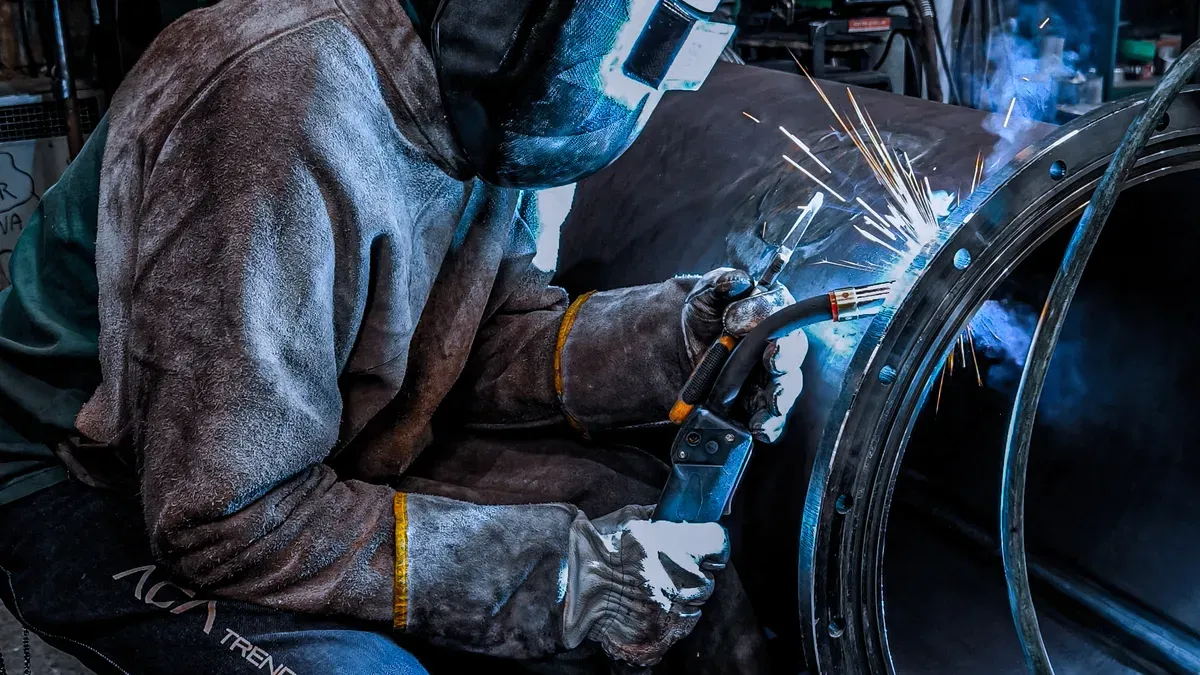
MIG welding (GMAW) uses a continuously fed wire electrode and a shielding gas to join metal pieces. The arc melts the wire into the joint, creating a fused weld. It is a semi-automatic process that is straightforward to learn and well-suited for thicker materials or long, continuous seams. For a broader comparison of welding current and process types, the American Welding Society's standards library is the definitive industry reference.[2]
TIG Welding
TIG welding (GTAW) uses a non-consumable tungsten electrode and a separate filler rod, with argon shielding gas protecting the weld area. It produces high-quality, precise welds and is ideal for thin materials and applications where appearance is paramount — such as stainless steel, aluminum, and aerospace components. TIG welding requires more skill and practice than MIG or stud welding.
Stick Welding
Stick welding (SMAW) uses a consumable coated electrode that creates both the arc and a protective slag layer. It is highly portable and effective in challenging outdoor environments, making it a staple for construction sites and field repairs. Equipment is simple and affordable, with no external gas cylinders required.
| Feature | Stick Welding | Stud Welding Torch |
|---|---|---|
| Equipment Cost | Low | Moderate |
| Portability | Highly portable, suitable for outdoor use | Portable; best for production settings |
| Field Use | Effective in varied environments | Controlled environments preferred |
| Ideal for Thin Workpieces | No | Yes (CD type) |
| Finish Quality | Requires slag removal and finishing | Clean, minimal marks |
Stud Welding Torch vs. Other Tools: A Direct Comparison
Process Differences
A stud welding torch does not require filler material, drilling, or tapping holes. The stud itself acts as the electrode. By contrast, MIG uses a continuously fed wire, TIG uses a tungsten electrode plus a hand-fed filler rod, and stick welding uses a coated consumable electrode — all requiring more surface preparation and additional finishing steps.
Efficiency and Speed
The stud welding torch can complete a weld in under a second — up to 30 welds per minute manually, and up to 1,800 studs per hour in automated production lines. Key efficiency advantages include:
No need for grinding, polishing, or pre-drilling holes
No use of rivets, bolts, nuts, or washers
Lightweight and portable — one-person operation
High productivity for high-volume manufacturing environments
Weld Quality Comparison
| Welding Method | Weld Appearance | Finishing Required | Consistency |
|---|---|---|---|
| Stud Welding Torch | Smooth, minimal reverse-side mark | Rarely needed | Very high |
| MIG Welding | Visible seam | Sometimes needed | High |
| TIG Welding | Clean, precise | Sometimes needed | High |
| Stick Welding | Slag present; rougher | Often needed | Moderate |
Use Cases and Limitations
The stud welding torch excels for specific applications. Common industries include:
Automotive Manufacturing — attaching fasteners to body panels for smooth, strong connections
Construction — installing insulation pins, anchors, and brackets on steel structures
Electrical Equipment — fixing grounding studs and terminals to panels reliably
Shipbuilding — attaching studs to hulls and decks for durable, corrosion-resistant joints
HVAC Systems — securing mounting studs for ducts and equipment quickly
| Limitation | Description |
|---|---|
| Material Compatibility | Works mainly with steel, stainless steel, and aluminum |
| Thickness Requirements | Performs best on thin to medium-thick workpieces |
| Surface Condition | Requires reasonably clean surfaces for optimal welds |
| Application Scope | Not suitable for joining two separate metal pieces |
| Stud Size Range | Limited by the specific torch model and stud diameter |
Pros and Cons Summary
Stud Welding Torch
| Pros | Cons |
|---|---|
| Extremely fast welding cycle (under 1 second) | Limited to attaching studs or fasteners |
| Minimal surface preparation needed | Works best on specific compatible materials |
| Supports automation and high-volume work | Requires reasonably clean surfaces |
| Consistent, high-quality welds | Not suitable for joining two metal plates |
| Clean finish with little to no reverse marks | Stud size range limited by torch model |
| Portable and easy to operate | |
| Reduces labor and eliminates secondary operations |
MIG, TIG & Stick Welders
| Pros | Cons |
|---|---|
| Can join plates, pipes, and structural components | Slower for high-volume fastener attachment |
| Suitable for repairs and general fabrication | Often requires more surface preparation |
| Works with many metals and thicknesses | May leave visible seams or slag requiring removal |
| MIG and Stick are relatively easy to learn | TIG demands more skill and practice |
| Stick welding excels outdoors and in field conditions | Less efficient for high-volume stud attachment work |
For a comprehensive look at how air-cooled vs. water-cooled MIG torches compare in different scenarios, see our related guide.
Choosing the Right Welding Tool
When to Choose a Stud Welding Torch
A stud welding torch is the best choice when fast, reliable attachment of metal studs or fasteners is the primary requirement. Key selection criteria include:
Material Grade — Verify stainless steel grades (302, 304, 316) for corrosive environments
Stud Size Compatibility — Match stud diameter and length to your torch model
Industry Certification Requirements — Confirm equipment meets applicable codes for safety and traceability
Weld Validation — Request per-weld data logs, certificates of conformance, and bend/pull test documentation from your supplier
Environmental Demands — Choose materials rated for vibration, temperature cycling, or chemical exposure as needed
When to Choose MIG, TIG, or Stick
| Welding Method | Best Used When | Key Considerations |
|---|---|---|
| MIG | High material thickness, fast production, appearance not critical | Not ideal for very thin stainless tubes |
| TIG | Precision work, clean appearance, stainless or aluminum | Requires skilled operators |
| Stick | Outdoor work, field repairs, varied positions | Slag removal needed; adaptable but slower |
| Material | Strengths | Considerations |
|---|---|---|
| Steel | Strong, durable, widely used | May harden if carbon content is high |
| Aluminum | Lightweight, conductive | Requires special techniques due to melting point |
| Stainless Steel | Corrosion-resistant | More expensive; requires precise heat control |
For more on TIG torch selection and setup, see our complete TIG torch guide. And for applications requiring robot integration, our guide to robot welding torches covers key features and use cases in detail.
| Tool | Typical Use Cases | Main Limitations |
|---|---|---|
| Stud Welding Torch | Fastener attachment, automation, high-volume lines | Material and thickness restrictions |
| MIG Welding | Plate joining, fabrication, automotive body repair | Surface prep required; visible seams |
| TIG Welding | Precision welds, thin materials, aerospace | Slow; requires skilled operator |
| Stick Welding | Outdoor repairs, heavy structural work | Slag removal; rougher finish |
Need a Stud Welding Torch for Your Project?
Changzhou Golden Globe manufactures the LZHQ series of stud welding torches — covering capacitor discharge and drawn arc applications from 3 mm to 12 mm stud diameter. Contact our team for product specifications, OEM support, or a custom solution for your production line.
Request an Inquiry NowQuick response · Technical specifications available · OEM & custom orders welcome
Frequently Asked Questions
What is a stud welding torch?
A stud welding torch is a tool that attaches metal studs or fasteners to a workpiece using an electric arc to create a strong bond in under a second — ideal for high-volume production.
How does it differ from MIG or TIG welding?
A stud welding torch attaches studs directly to metal surfaces without filler material or drilled holes. MIG and TIG welding join two pieces of metal together and require more surface preparation and finishing.
What materials can a stud welding torch handle?
Most stud welding torches work with steel, stainless steel, and aluminum on clean, thin to medium-thick surfaces.
Is it suitable for automated production lines?
Yes. The LZHQ series supports automation, enabling up to 1,800 studs per hour, which significantly improves throughput and reduces labor costs.
Which industries use stud welding torches?
Automotive manufacturing, construction, shipbuilding, HVAC, and electrical panel fabrication all rely on stud welding torches for fast and reliable fastener attachment.
Does stud welding leave marks on the workpiece?
Stud welding creates a clean finish with minimal marking on the opposite side of the workpiece — a key advantage over drilling or conventional welding methods.
How do I choose the right stud welding torch model?
Match the torch model to your stud diameter, length, material type, and production volume. The LZHQ series offers purpose-built options for both CD and drawn arc applications.
References
Wikipedia — Stud Welding: Overview of drawn arc and capacitor discharge welding processes.
American Welding Society — Welding Standards & Publications: Industry codes and recommended practices for welding procedures and qualification.